


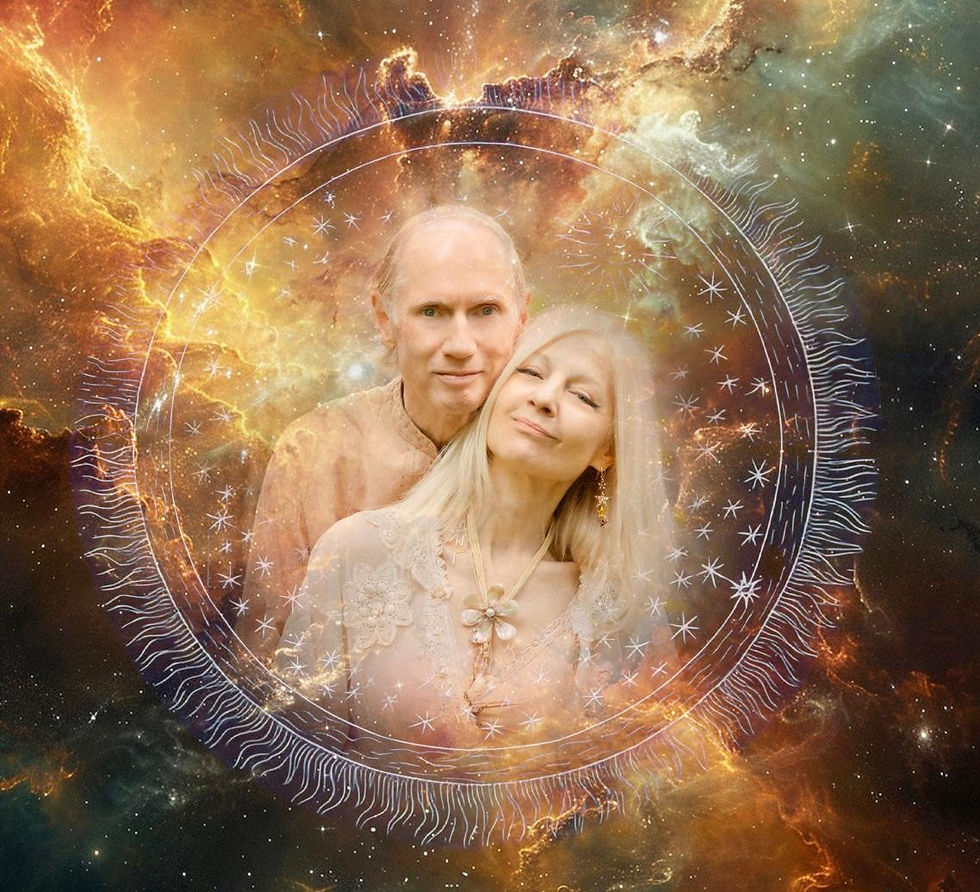
MARGEE MINIER-TUBBS & PREMIK RUSSELL TUBBS, In the Stillness of the Stars
Updated: Aug 10
Long before telescopes mapped distant galaxies or science revealed the staggering scale of the universe, people gathered beneath the stars seeking guidance, comfort and perspective, believing that somewhere beyond the noise of daily existence lay a deeper understanding of who we are and why we are here. Those heavenly lights have inspired mythology, religion, poetry, philosophy and music across countless civilizations, serving as enduring reminders that something infinitely larger surrounds us.

That timeless impulse toward wonder forms the spiritual heart of In the Stillness of the Stars, the extraordinary new collaboration by husband-and-wife creative partners Premik Russell Tubbs and Margee Minier-Tubbs. While many artists use the cosmos as a backdrop for dreamy ambience or abstract meditation, the duo approaches it as something far more intimate—a place where silence becomes revelation, where the distractions of everyday life gradually dissolve, and where listeners are invited to rediscover the quiet source of peace already residing within themselves.
If Oneness-World explored humanity’s profound interconnectedness with one another through an adventurous blend of jazz fusion, world music, spoken-word and global influences, In the Stillness of the Stars expands that vision outward toward the cosmos itself. Rather than asking us simply to recognize our shared humanity, it gently encourages us to look beyond it—to discover the larger universe from which that connection ultimately springs.
Margee articulates that progression beautifully: “In The Stillness Of The Stars takes this concept one step further in its journey to the cosmos, where we believe if listeners can leave man’s world behind and open their receptive hearts to see the radiant light in our celestial skies and hear the symphonic message woven into the tapestry of stars, one can find the source of all that exists within this luminosity…where we can experience eternal love.”

That concept’s origins stretch back nearly a decade through the couple’s live sound healing gatherings, where Premik’s meditative flutes, keyboards and world instruments intertwined with Margee’s Tibetan bowls, Koshi chimes, bells and guided spoken-word imagery. Participants repeatedly asked how they could recreate those experiences at home, inspiring Margee to begin assembling years of poetry, reflections and guided meditations born from her daily sacred practice. Those writings eventually became the foundation for this remarkable recording.
Every morning for more than a decade, Margee has devoted two uninterrupted hours to silent meditation before writing whatever emerges afterward. Surrounded by birdsong and sunlight filtering through the trees, she has filled hundreds of pages with reflections, poetry, prayers and intuitive observations. When inspiration for In the Stillness of the Stars arrived, it did so with astonishing force. She filled an entire spiral notebook with imagery, guided astral explorations and philosophical insights before a single note of music was completed. The original version of the title composition eventually stretched beyond forty minutes before she undertook the difficult process of refining it into the magnificent eighteen-minute centerpiece heard today.
Yet Margee’s journals represent only part of her artistic process. Before Premik ever begins composing, she often creates what she calls “conceptualization charts”—handwritten visual maps that chart not simply how a composition should sound, but where it should unfold emotionally, spiritually and even cinematically. Filled with flowing lines, stars, swirling cosmic sketches, handwritten cues and evolving insights, they resemble the notebooks of a filmmaker storyboarding an epic fantasy more than conventional musical scores. Alongside detailed notes describing instrumentation, pacing and imagery, they trace the expressive arc of each piece almost moment by moment, from the first shimmer of Tibetan bowls and Koshi chimes to soaring flute passages, Celtic landscapes, whispered prayers and luminous arrivals into contemplative peace.
One fascinating chart for “Ariitea (White Prince Coming Down From The Heavens)”—inspired by the Tahitian name meaning “White Prince Coming Down from the Heavens”—reads almost like the outline for an enchanted film. Horse hooves echo beneath Stéphane Wrembel’s guitar before Premik’s flute rises into what Margee calls “cosmic swirls.” Zach Brock’s violin gradually transforms the atmosphere from mysterious Middle Eastern colors toward Celtic and Scandinavian landscapes as Pegasus finally emerges, carrying the listener through radiant galaxies. Another handwritten note simply reminds herself that “my chimes add sparkles.” The final instruction is perhaps the most revealing of all: “My voice comes in…a vulnerable tone of prayer…peace…peace.”
The story behind the title reveals why the piece feels so deeply personal. During the years Margee lived in Tahiti, she planned to name her unborn son Ariitea, a Tahitian name meaning “White Prince Coming Down From the Heavens.” Although family circumstances ultimately led her to choose another first name, Ariitea remained his middle name, and decades later became the inspiration for one of the album’s most luminous compositions. Yet the piece reaches well beyond autobiography. As Margee describes it, the music wanders through Camelot, follows Lancelot's courage, encounters Merlin’s magic and ultimately watches Pegasus soar into luminous skies. It becomes a meditation on every soul’s capacity to emerge from darkness with grace and hope.
These sketches reveal something profound about the partnership Margee and Premik have cultivated. Their music rarely begins with notes on a page. Instead, it often begins as a fully imagined soulful landscape, where imagery, movement, color and ambience exist long before the first melody is performed. Premik’s singular gift lies in translating those deeply intuitive visions into richly textured musical experiences without diminishing their mystery. The result is neither conventional New Age music nor straightforward jazz fusion. Instead, In the Stillness of the Stars inhabits its own beautifully distinctive realm where world music, Celtic traditions, Indian classical influences, ambient textures, improvisation, guided meditation and cinematic storytelling coexist naturally.
Just as important is the impressive community of musicians the duo assembled to help realize that vision. Rather than simply recruiting celebrated virtuosos, they sought artists capable of surrendering themselves completely to the spirit of each composition. Grammy-winning violinist Zach Brock returns following his inspired work on Oneness-World, his playing once again balancing technical brilliance with an almost intuitive sensitivity. Legendary guitarist Stéphane Wrembel contributes acoustic textures that move effortlessly between Celtic imagery, Gypsy jazz lyricism and impressionistic sound painting. Indian percussion master Swaminathan Selvaganesh brings decades of collaboration with Premik into rhythmic conversations that feel simultaneously ancient and spontaneous, while Grammy-nominated pianist Charu Suri adds graceful East-West harmonic colors. Danish vocalist Anita Lerche contributes luminous vocal passages that seem to hover effortlessly between earthly song and starlit invocation.

For Margee, these collaborators were chosen as much for their inner lives as their technical gifts. She speaks repeatedly of musicians who seem able to access “realms beyond,” artists whose performances feel less manufactured than received. That philosophy explains why improvisation occupies such a central place throughout the recording. Some pieces were meticulously composed, while others evolved almost entirely through spontaneous interaction once the musicians gathered.
The album opens with perhaps its most immediate symbolic statement. “11:11” draws upon the familiar numerical sequence often associated with awakening, synchronicity and heightened awareness. For Margee, repeatedly encountering those four digits serves as a daily reminder to pause, remain present and realign with something larger than ordinary existence. That simple numerical image becomes the perfect doorway into the album’s unfolding odyssey. The composition begins almost imperceptibly through shimmering chimes, singing bowls and softly gathering percussion before Premik’s graceful flute emerges like the first rays of morning light. Zach Brock’s violin enters with soaring improvisational flights while Premik alternates between flute and exhilarating soprano saxophone excursions that propel the music into exhilarating jazz fusion territory.
Throughout the performance, Margee’s carefully chosen bells, wind chimes and Tibetan bowls function less as decorative embellishments than as subtle reminders that stillness itself possesses its own musical vocabulary. By the closing moments, as the instrumental intensity slowly dissolves and Margee whispers the word “peace” in an almost prayerful echo, listeners realize they have quietly crossed an invisible threshold into the larger transcendent landscape awaiting them.
If “11:11” opens the doorway, the eighteen-minute title composition invites listeners to step fully through it. Far from feeling overextended, In the Stillness of the Stars unfolds as an immersive five-part passage whose pacing reflects the gradual rhythms of meditation itself. Ethereal orchestral textures, shimmering synthesizer elements, oceanic soundscapes and Premik’s lyrical flute establish an expansive sonic horizon before tribal percussion slowly begins to pulse beneath the surface, suggesting less a destination than an awakening already taking place.
At its center stands Margee’s spoken-word meditation, delivered not as narration but as another melodic voice within the ensemble. Rather than explaining ideas intellectually, she subtly guides listeners toward them through poetic invitation: encouraging them to “leave man’s world behind,” to “see with your heart,” to recognize the stars as “windows into the beyond,” and to discover within the vastness of the universe a sanctuary where fear gradually gives way to belonging. Her words never interrupt the music; they breathe with it, floating effortlessly alongside Premik’s delicate flute phrases and understated acoustic accompaniment.
The composition reaches another level with Anita Lerche’s breathtaking vocal entrance. Singing not as a traditional featured vocalist but almost as an ethereal presence emerging from the surrounding textures, she transforms Margee’s contemplative reflections into soaring melodic affirmation. Supported by gracefully flowing percussion, expansive synthesizer washes and Premik’s expressive instrumental responses, her voice seems to suspend time itself, allowing the composition to move seamlessly between guided meditation, world fusion, contemporary classical textures and inspired improvisation.
If the opening half of In The Stillness Of The Stars establishes Premik Russell Tubbs and Margee Minier-Tubbs’ expansive vision, the remainder of the album invites listeners to inhabit that universe through a series of richly imagined musical landscapes where personal memory, mythology, improvisation and contemplative beauty continually intersect. While each composition possesses its own distinct identity, they all feel like different pathways leading toward a place where earthly experience gradually gives way to wonder, gratitude and a renewed awareness of something far greater than ourselves.
That same deeply personal spirit shapes “Lumière (Prayer for Archangel Mikaël),” perhaps the album’s most intimate expression of faith. Built upon resonant organ textures, spacious ambience and Premik’s exquisitely restrained instrumental performances, the composition unfolds as a tender prayer rather than a formal religious statement. Margee’s whispered French invocation to the Archangel Michael stems from words she has repeated throughout her life during moments requiring strength and courage, even naming one of her sons Mikaël in honor of that enduring spiritual presence. Margee's ethereal vocal becomes less a featured performance than another beam of light within the arrangement, floating effortlessly alongside Premik's soaring flute and soprano saxophone. As the music gradually expands into freer improvisation before settling once again into peaceful repose, the piece beautifully embodies a key recurring idea—that prayer itself can become music, and music can become prayer.
While “Lumière” looks upward for guidance, “TaraShanti (Love’s Eternal Angel)” offers a heartfelt blessing to future generations. Meaning "Star Peace," the title carries layers of meaning accumulated across Margee’s multi-faceted life path, from discovering Georgia Kelly’s influential harp recording decades ago to eventually bestowing the affectionate nickname TaraShanti upon the tiniest angel in her life. Those personal threads are woven into one of the collection’s most elegant performances, where soft guitar, graceful flute, shimmering chimes and Margee’s angelic vocal create an aesthetic of quiet reassurance rather than dramatic declaration. Margee’s spoken words encourage the title figure to “spread your wings” and “shower us with your love,” transforming the composition into both lullaby and universal prayer. The gradual blossoming of the arrangement perfectly mirrors another image Margee shared while reflecting on the album: a flower slowly emerging from a seed, blooming brilliantly before gracefully yielding to renewal.
Another invigorating surprise arrives with “Star of Shayan,” where contemplative meditation blossoms into joyful celebration. Charu Suri’s elegant piano, Swaminathan Selvaganesh’s dazzling kanjira rhythms and Premik’s lyrical bansuri flute engage in a vibrant dialogue that demonstrates how naturally world music, jazz improvisation and spiritual expression can coexist. Dedicated as a tribute to Suri and inspired by the enduring friendship she shares with Premik and Margee, the composition carries an infectious sense of optimism without ever abandoning the album’s central theme. The musicians elevate the music’s dramatic momentum, suggesting that enlightenment need not always arrive through silence; sometimes it emerges through movement, spontaneity and shared musical conversation.
The closing piece “In the Silence of The Night” softly returns listeners to the quiet from which the sonic adventure first emerged. Zach Brock’s sensual violin, Premik’s deeply expressive flute, shimmering Tibetan bowls and Margee’s delicate chimes create a spacious soundscape where every note seems suspended between earth and sky. Inspired in part by medieval melodies Margee’s father introduced to her during childhood, the piece feels timeless, blending echoes of ancient spirituality with contemporary ambient textures. The result is less a conclusion than an invitation to linger in reflection long after the final notes disappear.
Perhaps the project’s crowning achievement lies in its seamless weaving of meticulous composition and inspired improvisation. Some pieces were carefully written long before entering the studio, while others evolved organically through the spontaneous interaction of artists she describes as possessing the rare ability to connect with “realms beyond.” That philosophy explains why every guest artist feels essential rather than ornamental. Each becomes a co-creator, helping realize a vision grounded equally in imagination, technical mastery and profound trust among collaborators.
That spirit of trust extends to Premik himself, whose unique versatility on flute, bansuri, soprano saxophone, EWI, lap steel guitar and keyboards continually shapes the album without ever overwhelming it. After decades performing with artists ranging from John McLaughlin, Carlos Santana and Herbie Hancock to Whitney Houston, Elton John and Lady Gaga, he acknowledges that projects like In The Stillness Of The Stars fulfill a deeper personal calling because they arise from "an inner source" rather than adapting to someone else's musical world. Yet he is equally quick to credit Margee's vision as the catalyst. "It was really Margee's musical vision which ignited the inner flame within me to help manifest this beautiful creation," he says—a generous acknowledgment of the artistic partnership that gives the album its unmistakable identity. Like the finest concept albums, while the individual pieces certainly reward repeated listening, their deepest resonance emerges when experienced as one continuous experience whose destination is not merely musical satisfaction but quiet transformation.
Reflecting on what she hopes listeners carry with them, Margee offers perhaps the album’s most beautiful summation: “When someone listens to In The Stillness Of The Stars uninterrupted from beginning to end, Premik and I hope that the listener will be carried on a journey to peace. We hope that this journey brings enlightenment... a greater ability to see the beauty that still exists in spite of the darkness that is so present today. And when the final notes fade away, we hope that the star of peace will feel attainable and within reach for all.”
In a world increasingly filled with distraction, noise and uncertainty, that aspiration may be the album’s greatest gift. Rather than asking us to escape the world, In The Stillness Of The Stars quietly reminds us to look beyond it—and perhaps, in doing so, rediscover the quiet light that has always been waiting above us and within us.
Streaming subscriptions can get messy when several devices, renewal dates, playlists, car connections, and payment records are attached to the same login. For a music app, I keep the account email, plan name, charge date, device list, app version, and any error screenshot in one place. That helps if the question involves premium access, billing, cancellation, password reset, station settings, or a feature that behaves differently on phone and desktop. I also note whether the issue happens on Wi-Fi, mobile data, or a car connection, since playback details can change by device. When I need platform support, I saved Iheartradio customer service number beside the billing note and account screenshot so the request stays tied to one subscription.
Sometimes a quieter record is exactly what you need. This one sounds like it might fit that spot. @slope
Butcher Me Not is a suspenseful psychological horror game visual novel created by independent game developer Arrokoth486958. Drawing creative inspiration from the popular Call of Duty franchise, the narrative thrusts players into an unsettling captive nightmare. You wake up bound inside a cramped, violently swaying chamber, struggling against icy restraints while realizing that escaping this tense story requires navigating a dangerous encounter.