


TERRY LEE NICHOLS, A Sky That Knows Our Names
Throughout the course of evolutionary events, melodies came long after motion. Before there were prayers, poems, languages or civilizations, there was light bursting into unimaginable darkness, stars forging the elements that would one day become oceans, forests, mountains—and us. Across the billions of years separating the first spark of creation from this very moment, humanity learned to wonder not only how we came to exist, but why our brief lives matter at all. While it’s a question explored by philosophers, scientists, theologians and artists throughout history, few contemporary composers have dared to approach it with the scope, imagination and quiet reverence Terry Lee Nichols brings to his latest epic project.
From the opening jungle percussion beats of “The Celestial Traveler” to the gentle piano and mystical chimes at the close of the concluding title track, A Sky That Knows Our Names comes to life as an extraordinary ten-part musical odyssey that traces the astonishing arc of creation, civilization and the enduring human spirit.

Nichols’ finest and most acclaimed recordings have always unfolded as unified artistic statements built around ideas larger than themselves. We Have Only Come to Dream (2017) contemplated humanity through migration and anthropology. The Pale Blue Dot (2020) invited us to consider our fragile existence within the immensity of the cosmos, while Love Is... (2025) explored the countless ways affection, devotion, friendship and gratitude shape our lives. Each represented another step in a creative evolution that has steadily expanded in both ambition and philosophical depth. Those richly realized concept albums now feel like preparation for the larger vision he fulfills with the new album.
Rather than presenting ten individual instrumental pieces linked by style or mood, Nichols conceived A Sky That Knows Our Names as a seamless narrative. Every composition serves as another chapter in an immense story stretching from the birth of stars through Earth's formation, the emergence of life, humanity's migration across continents, the rise of civilization, our search for meaning through faith and ultimately the profound gratitude that comes from recognizing our place beneath the same sky shared by every generation that came before us—and every generation still to come. “I thought of it almost as a film without images or words,” he says, “with each composition illuminating a different stage of the journey while remaining part of one continuous story. The title phrase holds both the intimacy and immensity I wanted the project to convey.”
That sweeping concept demanded an equally expansive musical language. While Nichols is, as always, the creative center of the project through his lyrical touch on the ivories, his impressive piano performances serve as the foundation for the expansive cinematic production. Recorded with the magnificent Budapest Art Orchestra and enriched by a remarkable ensemble of guest artists, A Sky That Knows Our Names often unfolds like a cinematic tone poem where orchestral colors, ambient textures, expressive percussion, ethereal voices and carefully chosen instrumental solos become equal partners in the intricate chronicling. Nichols isn't simply composing melodies; he is deftly building worlds.

His companion booklet, filled with breathtaking artwork and poetic reflections, deserves recognition as more than traditional liner notes. Like the finest film scores accompanied by unforgettable imagery, the visual narrative deepens rather than explains the listening experience. Science, history, faith and imagination coexist naturally throughout its pages, inviting listeners to contemplate creation through multiple lenses without insisting upon any single conclusion.
Nichols says that harmony was part of his vision from the outset. “Science helps us explore how the universe developed,” he explains, “while faith asks us to consider meaning, purpose and our place within in it.” Instead of treating those perspectives as opposing worldviews, he allows them to illuminate one another. Scientific discovery never diminishes our sense of awe – it deepens it, making curiosity itself one of the album’s quietest yet most profound themes.
Perhaps the most revealing insight into Nichols’ artistic philosophy has little to do with cosmology, geology or history. Reflecting on how his approach has evolved over the years, he says, “Earlier in my career, I focused more on the craft of composition and on expressing a particular musical idea. As I matured—both as a composer and as a person—I became increasingly interested in what the music might awaken within the listener.” He eventually arrived at a realization that quietly shapes every measure of A Sky That Knows Our Names: “Music does not need to explain or persuade. Its greatest power may be its ability to create a quiet space where listeners can reflect, feel, and connect with something beyond themselves.”
Nichols adds that while he can shape the journey, every listener brings “personal experiences, beliefs and emotions” to it. That openness may be the album’s greatest achievement. Rather than prescribing what to think, A Sky That Knows Our Names trusts us to arrive at our own understanding, whether we approach it through science, faith, memory, gratitude or subtle contemplation.
That philosophy explains why this remarkable album never feels like a lecture disguised as art. Rather than illustrating history or science literally, Nichols invites us to inhabit those moments—to imagine the first stirrings of life, the birth of language, the rise of civilizations and, ultimately, the quiet gratitude that comes from recognizing we are participants in one extraordinary human story.
The opening track "The Celestial Traveler" introduces humanity not through solemn grandeur but through life itself springing joyfully into motion. Earthy percussion, tribal rhythms, spirited piano improvisations, playful flute conversations and Guadalupe Ravenos' infectious scat vocalizations create a vibrant celebration of movement and curiosity. Rather than portraying prehistoric humanity as primitive, Nichols emphasizes qualities we continue to recognize within ourselves—exploration, resilience, community and an irrepressible instinct to keep moving forward. Dave Manington's buoyant upright bass subtly anchors the groove while Nick Bisese's dancing flute adds an almost childlike sense of discovery.

The cosmic perspective broadens with "In the Beginning, Light Danced," one of the album's most breathtaking achievements which transforms astrophysics into something sacred. Swirling ambient textures gradually surrender to soaring wordless vocals by Rebekah Eden, whose remarkable voice serves not merely as a featured vocal but an elemental force participating in creation itself. Nichols' elegant piano lines drift through shimmering orchestral colors while celestial synth atmospheres continually expand the sonic landscape. The result feels simultaneously intimate and infinite—a remarkable balancing act that characterizes the entire album.
"Hadean Fire" may be Nichols' boldest composition to date. Rather than attempting to illustrate geological violence literally, he captures the primal force of Earth's earliest convulsions through primal rhythms, haunting vocal incantations, dramatic orchestral surges and passages of remarkable restraint. After enormous waves of sonic turbulence, the music suddenly withdraws into tender piano meditations beautifully joined by Joasia Cieślak's expressive cello, reminding us that creation is never merely explosive—it also requires stillness, patience and grace.
From there, Nichols masterfully shifts between grandeur and intimacy. "Snowball Earth" glistens with crystalline orchestral textures that gradually dissolve into one of his loveliest piano performances, while "The Dawn of Life" unfolds with hypnotic patience through rainfall, delicate flute passages, lyrical strings and Hanna Rabe's exquisite harp, allowing the miracle of life to emerge almost imperceptibly. Nothing feels rushed. Nichols understands that evolution itself unfolds through gradual transformation rather than dramatic shortcuts, and his pacing reflects that intuitive wisdom.
The album's reflective midpoint arrives with the understated beauty of "Devonian Dusk." After the monumental landscapes preceding it, Nichols turns inward, allowing simple melodic ideas to breathe within spacious arrangements that reveal his maturity as both composer and pianist. His touch remains unmistakably lyrical, yet every phrase seems less concerned with technical display than with inviting contemplation. Few contemporary instrumental composers understand silence quite as well as Nichols does, and the spaces between notes here become every bit as meaningful as the notes themselves.
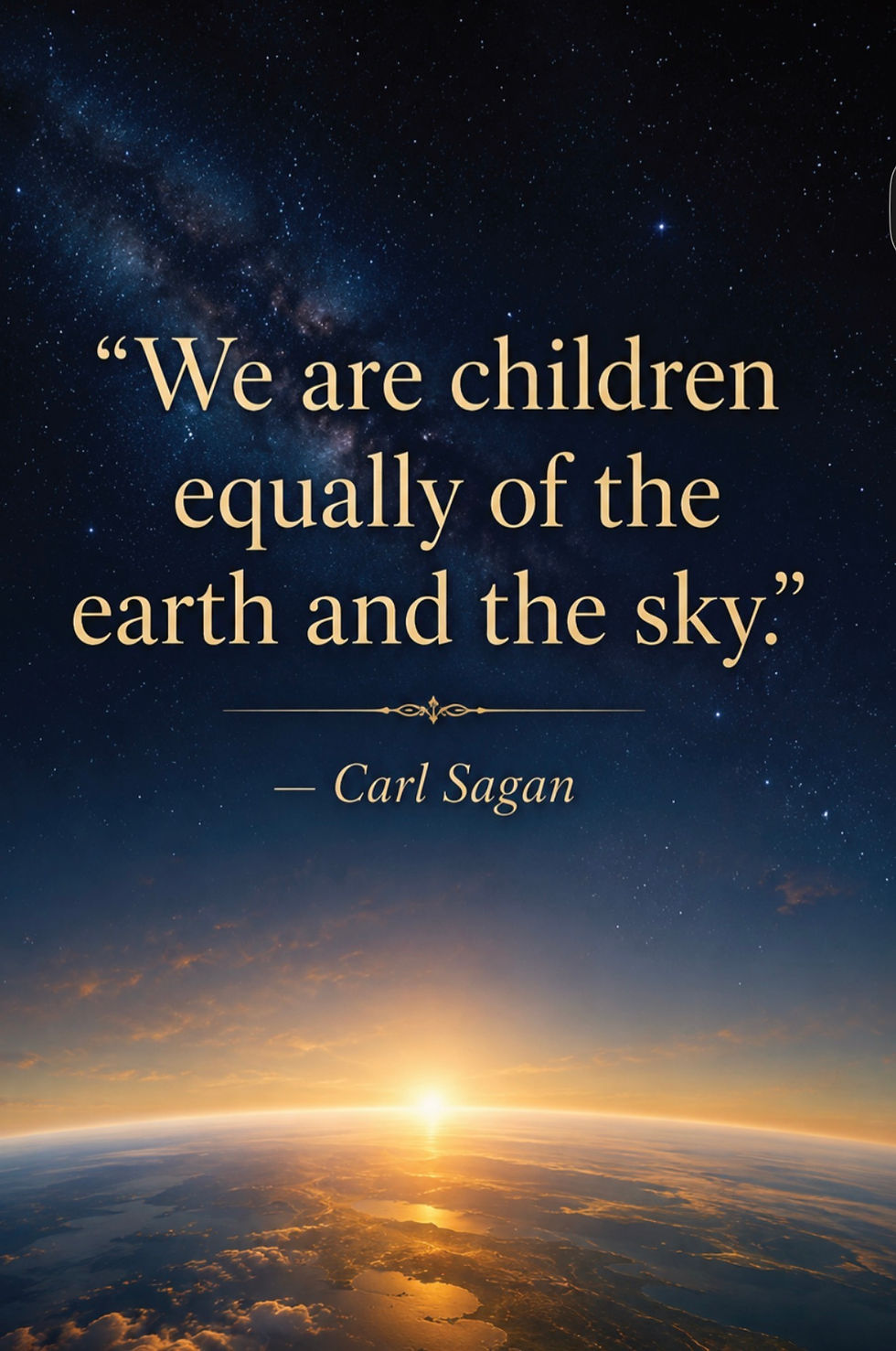
The narrative shifts fascinatingly with "Babel," one of the album's most inventive soundscapes. Baby coos, whispered voices, fragmented vocal textures and dramatic orchestral gestures gradually suggest humanity discovering language—perhaps our greatest invention and our greatest source of division. Nichols avoids presenting the biblical story as doctrine. Instead, the track becomes a poetic meditation on communication itself: language's remarkable ability to unite, inspire, confuse and separate us simultaneously.
"From Stone We Built the Sky" broadens the canvas once again, celebrating humanity's astonishing capacity for creativity and construction. Hypnotic piano figures gradually give way to soaring orchestral passages and an exhilarating electric guitar that briefly shifts the composition into symphonic prog rock territory before gracefully returning to its contemplative origins. Rather than sounding stylistically fragmented, the modulating textures reflect civilization's own relentless expansion through architecture, engineering, art and imagination.
By the time Nichols reaches "In Grateful Silence," the collection gently begins releasing its accumulated momentum. Spacious ambient resonance, restrained piano and subtle spiritual overtones create one of the recording's most meditative moments. After tracing billions of years of cosmic, geological and human history, Nichols understands that the appropriate response isn't triumph but humility. We pause—not because the story has ended, but because we've finally become quiet enough to appreciate it.
That realization blossoms fully in the luminous title composition. Graceful acoustic guitar, tender orchestral swells, delicate woodwinds, harp and Rebekah Eden's wordless vocalizations intertwine with extraordinary elegance, creating a musical realm that seems suspended somewhere between prayer and remembrance. Rather than delivering a dramatic finale, Nichols offers something far more enduring: acceptance. Gratitude. Wonder. The piece breathes with remarkable warmth, allowing listeners to linger inside the simple realization that despite our countless differences, we remain participants in one continuous human story.

Throughout A Sky That Knows Our Names, Nichols wisely avoids easy sentiment or grand pronouncements. In lieu of definitive answers, he creates space for listeners to contemplate life’s biggest questions throughout their own experiences and beliefs. Whether contemplating stellar evolution, ancient oceans, human migration or faith traditions, he reminds us that some of our deepest truths are found not in certainty, but in curiosity, humility and ongoing contemplation.
The performances deserve equal praise. The Budapest Art Orchestra consistently brings remarkable depth, nuance and cinematic sweep to Nichols' expansive vision, while guest artists contribute distinctive voices without ever drawing attention away from the larger narrative. Rebekah Eden's ethereal vocals once again prove indispensable to Nichols' musical universe, Dave Manington's upright bass adds organic warmth, Joasia Cieślak's cello brings quiet poignancy, Hanna Rabe's harp shimmers with exquisite delicacy, Nick Bisese's flute dances effortlessly through several key passages, Guadalupe Ravenos' joyful scat singing gives early humanity an irresistible pulse, and Larry Aberman's sensitive percussion continually grounds even the album's most celestial moments in something unmistakably human.
Toward the conclusion of his beautifully illustrated companion booklet, Nichols writes that music should not shout the truth but lead us gently toward it. A Sky That Knows Our Names doesn't lecture about science or preach a specific theology. It doesn't attempt to solve humanity's oldest questions. Instead, it invites us to stand in awe beneath an ancient sky, recognizing that every breath we take contains atoms forged in distant stars, every language traces back to the same human voice, and every life—no matter how seemingly small—belongs to an unfolding continuum billions of years in the making.
Long after its final notes dissolve into silence, its greatest gift remains what Nichols hoped listeners would discover all along: a renewed sense of wonder, humility and gratitude for the extraordinary privilege of sharing this brief journey beneath a sky that, somehow, still knows our names.
Planning an overseas trip always involves figuring out how to stay connected, and https://vietsim.com/en/vietnam-guide/ caught my attention during that process. I checked its Vietnam eSIM page to learn more about mobile data options and find out what might work best for the length of my stay.
This write-up makes the topic easy to understand with a clear explanation. I enjoyed Slope 2 Online because every attempt feels unique. The endless course, quick gameplay, and smooth controls make it a fun experience for players of all skill levels.
That opening idea—that melodies came after motion, that there was light and stars before any song—really stuck with me. It’s a beautiful way to frame how music connects us to something much older than ourselves. By the way, I keep a free planning and optimization tool I like to share: https://satisfactorycalculator.net/