


HELLINGS at the Troubadour, West Hollywood, CA

Sixty-five minutes can change the way you see a rock singer. Brett Hellings had already made his case at the Whisky a Go Go three months earlier, blasting through a roughly 30-minute set with enough force to suggest what he could unleash if he ever had the room to really stretch out.
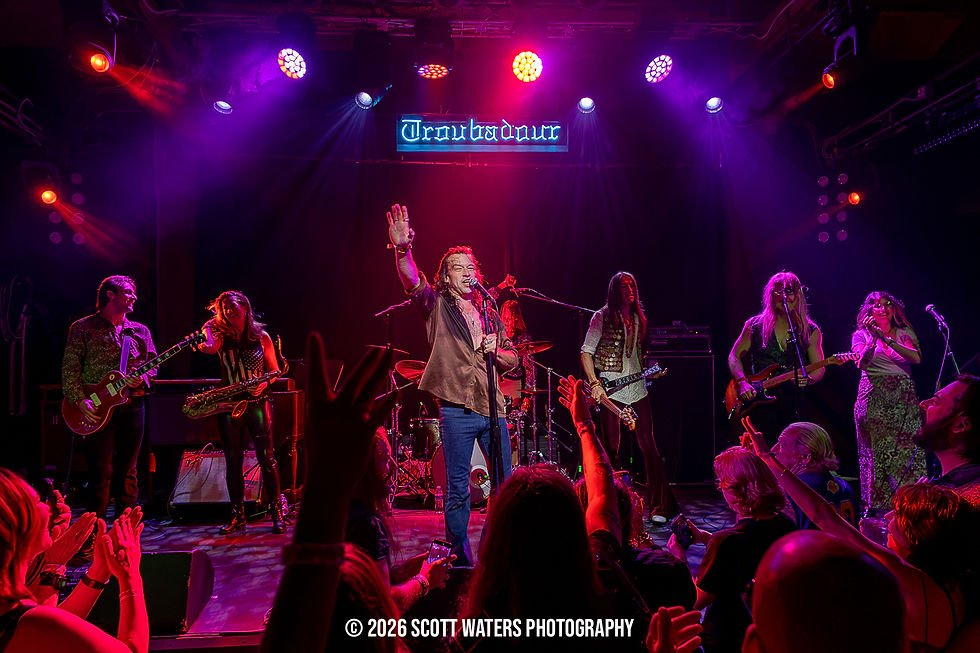
In early August at the equally legendary Troubadour, he finally had the time and space to do it. With the same restless hunger, a formidable seven-piece band behind him and more than twice the stage time, Hellings was liberated from having to cram his whole musical journey into a sprint. He could let the songs breathe, lean into the dynamics, turn loose on the mic, hand some of the spotlight to his killer ensemble and then reclaim it with the kind of physical abandon that leaves a singer reaching for a towel during someone else’s solo.
That extra time also revealed something important about Hellings’ career right now. For years, he has been the guy just outside the frame of wider recognition—the persistent, charismatic frontman who has kept writing, recording, assembling killer bands and finding his way into rooms with musicians whose names are already etched deeply into rock history. He has shared creative space with an extraordinary roster of players, from Richard Fortus and Tommy Hendrickson to Billy Sheehan, Kenny Aronoff and others, yet the name on the microphone remains the one that still deserves to be discovered by a much larger audience. Watching him command and electrify the Troubadour, however, it becomes increasingly difficult to understand how long he can remain a secret.
There was also something fitting about seeing Hellings in an iconic room like this. It’s a venue where understatement has never been a prerequisite for making an impression, where countless artists have learned that a smallish stage can accommodate an enormous personality. Hellings certainly brought one. He greeted the crowd warmly, talked about his love for Los Angeles and then seemed to shed any remaining distance between himself and his enthusiastic crowd once the music started. The transformation wasn’t theatrical in the manufactured sense - it was more like watching a switch get flipped. The affable guy addressing the audience gave way to a frontman whose entire physical vocabulary changed dramatically and dynamically once the first groove took hold.

The difference between the Whisky and the Troubadour wasn’t merely a matter of minutes. It was the difference between a concentrated blast and a fully developed set, one that eased effortlessly from the throbbing funk-rock attack of “Feet to the Fire” and “Borderline” into the bluesy pleading of “Where Will I Be,” the combustible obsession of “Rehab for Love” and the vulnerable sweep of “Kill Me to Keep Loving You.” The coolest surprise of the night was Hellings’ smoky, atmospheric – and totally unexpected - detour into “Riders on the Storm, - a callback to the halcyon days of late 60s L.A., which found Hellings ceding the stage midway through to John Nagle, the charismatic frontman for the famed Doors tribute band Mojo Risin’.
Along the way, the singer, true to trademark form, refused to conserve himself, even on the handful of ballads. He prowled, crouched, danced, bent into the mic, reached toward the audience and disappeared into the songs while his band supplied the kind of layered muscle required to make that enormous sound feel organic rather than merely loud.
As with the Whisky show, Hellings was also wise enough to surround himself with musicians who could match the scope of his vision without competing for the spotlight. Jake Faun and John Ashton supplied a formidable two-guitar attack, moving effortlessly between muscular riffs, bluesy fills and full-throttle solo exchanges, while Misha Adair’s keyboards gave the arrangements both vintage rock color and atmospheric depth. Zeus kept the bottom end throbbing, Andreas Brobjer brought a drummer’s sense of drama to every buildup and release, and Katja Rieckermann repeatedly stepped forward with saxophone lines that could be smoky and soulful one moment and absolutely scorching the next. Adi Argelazi Faun added a rich vocal presence that helped broaden the choruses without taking away from Hellings’ commanding leads.
It was a seven-piece band with enough firepower to make a very large sound, but what mattered most was the interplay: they listened intuitively to and conversed seamlessly with one another, leaving openings for the songs to breathe and genuinely energized by each other’s contributions. Hellings clearly knows that a frontman is only as compelling as the musical aesthetics surrounding him, and this lineup gave him a world expansive enough to roam around in.
That interplay became part of the visual drama, too. During instrumental passages, Hellings rarely just stood at the side of the stage waiting for his cue. He watched, reacted, danced, applauded and sometimes exchanged a quick embrace or shared moment with a bandmate. When Rieckermann launched into a saxophone solo, or one of the guitarists began peeling off a particularly fiery passage, Hellings seemed genuinely delighted to let them have the moment. Then, as if physically incapable of remaining still for long, he was back at the mic, ready to pull the song toward him again.
By the time he reached “Chance on Love,” his newest single, the evening had already covered considerable ground. Yet the song’s gentler, searching quality didn’t feel like a retreat but another window into the same artist—the guy who can spend one minute sounding like he might tear the roof off the Troubadour and the next pull the volume inward enough to make a quiet lyric linger. The song also demonstrated how naturally his current material can coexist with selections reaching back into his earlier catalog. Rather than feeling like a retrospective exercise, the set suggested a continuum: different chapters of a long-running musical life suddenly sharing the same stage.

Then, naturally, he went right back to work. “Live Fast, Die Pretty” sent him out of the spotlight and onto the main floor, where he sang and danced among enthusiastic friends and fans, sharing the moment rather than simply performing for them. “Jukebox Money” found him still roaming the stage deep into the set, while “Suzie” and “A Fool in Love” supplied the kind of back-to-back finish that could have left a younger performer searching for oxygen. Hellings, meanwhile, was still moving. His hair was soaked, his shirt saturated with sweat, yet his vocals continued to find another gear.
That’s the thing about watching Brett Hellings from close range. His records establish the voice, his long list of collaborations places him in the company of legendary musicians, and his songwriting reveals an artist with plenty still to say. But put him on a stage with 65 minutes to play with and the equation changes. You see the intense perspiration, the instinct, the theatricality, the humor, the generosity toward his bandmates and the almost unreasonable amount of physical commitment he brings to every phrase. You hear a frontman who hasn’t stopped believing that the next room might be the one where everything finally clicks—and who performs as if the only way to find out is to leave absolutely nothing in reserve.
At the Troubadour, blissfully, and with ear ringing intensity throughout, that conviction had an opportunity to evolve with breathtaking power. This time, he had the luxury of taking the long way around—and discovering, along with everyone in the club, just how much territory he can cover when nobody asks him to hurry.

Comments