


JAY D'AMICO, Melodia
Updated: Jan 5
Thinking back to the sensory and soul transforming experience of immersing in veteran pianist Jay D’Amico’s Ginevra: a portrait of little girl blue, I realize that I was perhaps more focused on his fascination for all things Da Vinci and why he chose to expound musically on his emotional connection to the iconic painter’s “other” masterwork than on the mastery and dynamics of his newly formed trio (his brother, bassist Greg D’Amico and drummer Michael Fox) and how the album expanded upon the ongoing adventures and innovations of his artful fusion of the two great musical loves of his life – classical European music (particularly, Chopin and Italian Opera) and American jazz.
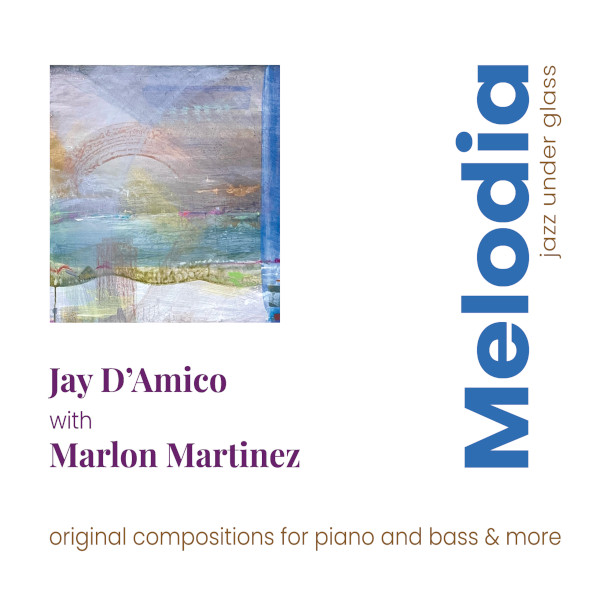
Without such prominent cultural and historical themes and inspiration to consider – not to mention an album cover featuring a classic, endlessly intriguing Da Vinci portrait - taking a likewise deep dive into D’Amico’s previous album Melodia (2024) allows the listener to focus solely on the brilliance and diversity of the music. The album cover features a lovely impressionistic painting and the simply stated but also slightly enticing intention/theme of the collection: original compositions for piano and bass & more. True to its title, the many moods, styles, influences and rhythmic variations are grounded in and driven by the pianist’s ever blooming passion for compositions that are melodic and singable.
One of the greatest differences between Melodia and any other of D’Amico’s recordings is the one-time shift from his usual trio, quintet or ensemble setting to an intimate piano/bass setting – and he felt that because of the nature of the compositions, it had to be a duo. D’Amico had been searching for years for a bassist that was equally proficient in “arco” playing (with the bow) and jazz, which he admits was difficult to find. He wrote to legendary L.A. based bassist John Clayton (who like D’Amico, is a disciple of the great Milt Hinton) and his first recommendation was Marlon Martinez. Watching a YouTube video of Martinez playing solo bass on a Bach piece, he knew he’d found his partner for the project. Martinez immediately agreed and the two set things up when he visited NYC. D’Amico sent him the music but when they first met in person, they shook hands and started rehearsing and recording what the pianist calls “this difficult music.”
That’s of course D’Amico’s take on the repertoire, but in the capable, ever supple and adventure-ready hands of him and Martinez, every note, ever bar, every chord change, every groove variation and every solo flows effortlessly and with freewheeling spirit and flair. Though it comes in the middle of the tracking, the inspiration and focal point for the project came from the three movement “Sonata for Piano and Bass” that the pianist composed some years ago in classical sonata form.
The elegant and intimate “Mvt. 1” is a great entry point into the immediate chemistry and dynamic between D’Amico’s soul-searching piano melody and Martinez’s darkly haunting bowing, followed by some jazzier swinging over the plucked basslines, then back. “Mvt. 2” follows the same compelling pattern, from shadowed melancholy balladry featuring the bow to a burst of lively, rhythmic sunlight – and back of course. “Mvt. 3” on the other hand, pops with joy from the start, with D’Amico’s exuberant melody alternately racing and meditating over Martinez’s snappy support. Though it’s an original composition, listeners may think at first that it’s a contemporary jazz spin on a famous classical piece they can’t quite place.
D'Amico felt that the other compositions he presents on Melodia, including his fresh, transcendent takes on the 40s standard “Tenderly” and John Coltrane’s “Giant Steps,” are similar in the sense that they have lyrical melodies and a sense of emotional intimacy that make them perfect fits on this recital program. To him, from the thoughtful, reflective and meditative musings of the title track through the ultra-infectious, breezy and whimsical closer “Closing Theme” (one of the many showcases for Martinez’s expansive virtuosity), the overall concept and narrative of the collection is its live recital quality and the deep intuitive connections he develops not only with the bassist but with the listener. There’s obvious musical contrast between each track but there’s also that sense of unity.
In addition to his love for blending jazz and classical music, one of the other great recurring threads in D’Amico’s music has been his heritage based exploration of Italian music – an exploration that began with Ponte Novello – a 1999 piano trio/string quartet performing Puccini, Bellini and Verdie – and later including the 2008 trio album Tuscan Prelude and of course, Ginevra. On Melodia, he becomes the jazz/classical equivalent of actor Stanley Tucci (Searching for Italy) via four different pieces.

There’s the jaunty, charmingly ambling jazz swinger (with colorful rhythmic variety along the way) “Preludio a Vinci,” written in Italy when he and his brother Greg visited the town of Vinci, the birthplace of Leonardo. Then “Toccata,” a nifty and super-hip snapshot of sorrow and gloom parting for more fun and truly sunnier excursions which perfectly exhibits D’Amico’s deft touch and technique. “Barcarola” is a sparkling classical/jazz ballad artfully fusing sheer elegance and a spirit of childlike joy, aptly named after a traditional Venetian gondolier’s song characterized by a gentle rocking rhythm. Placed earlier in the set, D’Amico and Martinez go to town on the jubiliant, wildly whimsical “Tarantella,” which true to its name is the pianist’s expression of a fast, lively Italian folk dance (most popular in Southern Italian culture) with quick nimble steps, originating from a legend about curing tarantula bites through frenzied dancing.
Another essential piece is the one D’Amico uses to draw us into the Melodia experience – the uniquely titled “Mixolydian Passage,” an infectious romp introducing the fanciful magic the pianist creates with Martinez and so named because the main section is in the mixolydian mode, a major scale with a flatted 7th, which gives it a modal sound. For those listeners not up on such technicalities, it’s a lighthearted tune with some truly compelling duality and solo action. Fun fact: John Lennon penned “Norwegian Wood” in this mode, and like D’Amico says, “although he probably didn’t know it was mixolydian, he certainly heard it, which is the important thing.” The pianist pays clever homage to this connection by inserting a few notes from the Beatles classic at the end of the piece – and, is happy to say, he hasn’t been sued by Yoko!
Comments