


MEMORY BECOMES MUSIC: FABIO BANEGAS AND THE REDISCOVERY OF JOSÉ ANTONIO BOTTIROLI
Writing Memory into Sound
Classical pianist Fabio Banegas’ journey toward bringing to life the complete piano works of Argentine composer José Antonio Bottiroli (1920–1990) has been a long-term, creatively empowering act of artistic dedication—a momentous effort to restore the voice of a largely overlooked composer to the international classical conversation.
This purposeful mission, fueled by Banegas’ enduring vision, now culminates with the release of Mementos, the fourth and final installment in his ambitious Bottiroli series for Grand Piano, the specialized piano label of Naxos Records. The album gathers the remaining works in the composer’s piano catalogue while expanding the scope of the project through dynamic collaborations with chamber musicians and an orchestra.

The Final Installment: CD4 “Mementos”
The final installment, CD4 Mementos, offers a particularly revealing portrait of the composer’s artistic world and his remarkable tendency to draw inspiration from personal memories. These musical portraits capture moments from life, people who influenced him, and imagery derived from imagination and nature. By writing memory into sound, Bottiroli’s works become "mementos" of his life.
The album opens with Symphonic Impressions for Piano and Orchestra on Themes by Mario Tarenghi, the composer’s earliest extant piece (1955). Dedicated to his friend, the Italian Reverend Father Mario Bernasconi (1893–1974), it is the recording’s most expansive moment, featuring Fabio Banegas as soloist with the Brno Philharmonic Orchestra under the direction of Francisco Varela.
Evolution and Musical Ethos
Unlike the earlier volumes, Mementos follows a roughly chronological arc that extends to works written as late as 1989. This temporal sweep allows listeners to trace the evolution of the composer’s voice across more than three decades. Banegas also grouped certain works thematically; for example, several pieces artfully explore polyphony, revealing Bottiroli’s deep engagement with contrapuntal traditions. One piece on the album, Viejo (Old)—the eighth track—draws specifically on Bach’s contrapuntal language, demonstrating Bottiroli’s ability to inhabit the Baroque idiom of his much-admired master while filtering it through his own expressive sensibility.
As in Viejo (Old), most of Bottiroli’s music embodies what Banegas terms "musical ethos," which he defines as musical portraits illustrating the psychological depth of a person or Bottiroli’s own interpretation of a subject's life. An example is Invisible Bird (CD1), where the composer describes the life of the timid South American bird called the Crespín—a true ornithological study in music.
Global Collaboration and Premieres
The international scope of the project reflects its wide cultural significance. Musicians from Argentina, Spain, Austria, and the Czech Republic came together to interpret works that had never been recorded. For many, the sessions represented a first encounter with Bottiroli’s music—an introduction made possible through Banegas’ long-standing commitment to the composer’s legacy.
CD4 Mementos also offers Bottiroli’s complete works for two pianos, revealing the composer’s broader creative writing style. This mission was entrusted to the Antón & Maite Piano Duo (Maite León and Antón Dolgov), who are widely regarded as one of the leading piano duos of their generation.
For Antón and Maite, participating in the project aligned naturally with their mission of championing lesser-known composers. “Recording an album of world premieres was very appealing to us,” they explain. They were particularly struck by the stylistic breadth of the compositions: “His music moves easily between lyricism and rhythmic vitality. As performers, that contrast gives us an enormous expressive palette.” Their riveting interpretation of Bottiroli’s Suite Argentina reveals the composer’s engagement with Argentine folklore, such as the chamamé and malambo, alongside neoclassical and modal textures.
Speaking of their connection to Bottiroli’s work, the duo says: “A true artist is not only someone who masters a craft, but someone who constantly searches for new ways to express himself and leave a human imprint. When one listens to the composer’s music—with its variety of styles, dances, and colors—it becomes clear that Bottiroli was a fascinating personality, driven by a love of knowledge and life itself.”
Like many involved in this last recording, Antón and Maite encountered Bottiroli’s music for the first time through Banegas. “Before Fabio introduced us to this repertoire, we had never heard Bottiroli’s music. Discovering it was a wonderful surprise.” They were equally impressed by Banegas’ dedication: “His enthusiasm is contagious; you immediately feel how deeply he believes in this music.”
Chamber Music Counterparts
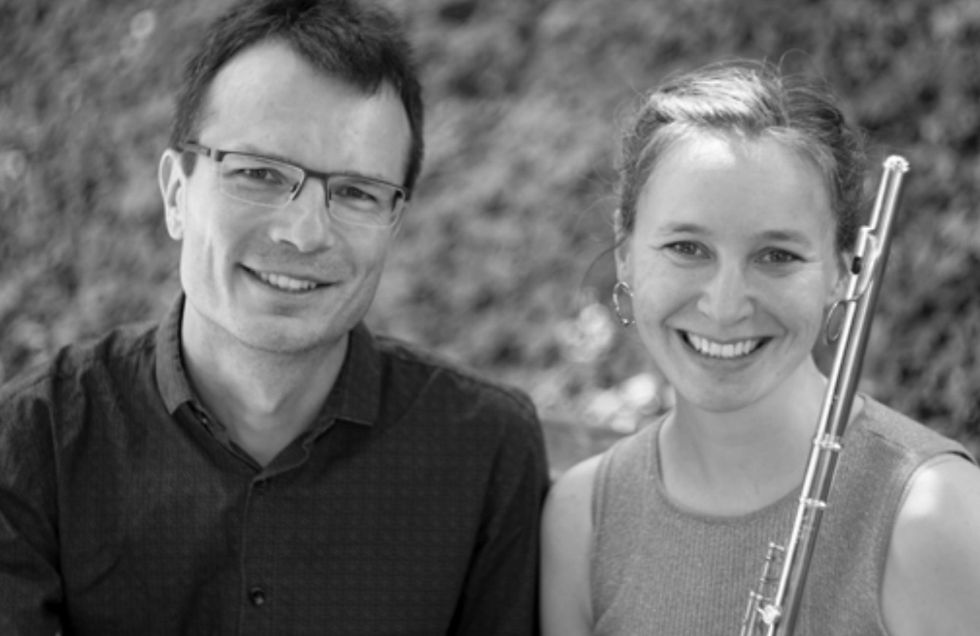
The collection includes Melody “Memento” for Flute and Piano, a lyrical work interpreted by the Czech Duo Du Rêve (flutist Jana Jarkovská and pianist Bohumír Stehlík). The piece reflects Bottiroli’s gift for intimate melodic writing and offers a chamber music counterpart to the album’s larger works.
“At first the piece seems simple,” Stehlík notes, “but every time you return to it, you discover new layers.” For Jarkovská, the work’s emotional sincerity was compelling: “There is a quiet sincerity in Bottiroli’s music; the flute line feels almost like a human voice speaking.”
Stehlík explains that Fabio guided them through the character and atmosphere of the piece. “His commitment to the project is inspiring,” adds Jarkovská. “You feel that he is not only performing the music but protecting its legacy.”
The Recording Process in Brno, Czech Republic
The recording sessions took place in the historic Besední dům concert hall in Brno, Czech Republic and the Brno Philharmonic with more than sixty musicians gathered to record the orchestral and chamber works.
“I had known Bottiroli by name, but I had not heard his music until meeting Fabio,” conductor Francisco Varela explains. “Bottiroli’s music carries a strong expressive voice and a romantic sensibility that deserves to be heard.” For Varela, the experience was an exciting musical unearthing: “You suddenly realize there is a whole expressive world in this music that had been largely hidden.”
Varela also emphasizes the music’s structural clarity: “The writing is deeply expressive while also being very well crafted.” He suggests that Bottiroli would be thrilled by the work of his mentee: “Fabio’s passion for this repertoire is extraordinary; without that commitment, this music might still be unknown.”
Continued Legacy and Cultural Heritage
In 2025, following the Brno recordings, Varela further immersed himself in Bottiroli’s symphonic works. He programmed and recorded Bottiroli’s unique Nocturnalia for Four Flutes and String Orchestra (1981) with the Chamber Municipal Orchestra of Rosario (OMCR) and a flute quartet featuring Verónica de Giannantonio, Emiliano Zamora, Susana Rinesi, and Martina Rodríguez. This recording will be featured on Allegro HD, South America’s premier classical music channel, and will eventually be released on CD.
Born in Rosario, Argentina, in 1920, José Antonio Bottiroli was a prolific composer, conductor, poet, and educator. His works reflect a blend of European Romantic tradition and Argentine influences. Beneath the elegant surface lies a fascinating intersection of heritage—particularly his Italian roots—while remaining deeply connected to the spirit of his homeland.
For Banegas, recording in Brno carried special resonance. His grandparents originated from the Moravia region, and bringing the music of an Argentine composer to that landscape felt like a symbolic homecoming. The Brno Philharmonic, founded through the efforts of Leoš Janáček, is considered the living heartbeat of Moravian musical identity.
Archival Significance
The result is a formidable musical language that feels both cosmopolitan and uniquely intimate. Bottiroli’s writing balances lyrical beauty with psychological intensity. Despite this rich output, much of Bottiroli’s catalogue remained unpublished until Banegas recently released the scores through Golden River Music in Belgium, alongside this multivolume recording project.
By recording the composer’s complete piano works and collaborating with world-class musicians, Banegas has preserved a significant body of music and reintroduced a nearly lost voice. Few recording projects dedicate this level of attention to a single composer outside the established canon. Together with the previous recordings—Waltzes (2020), Nocturnes (2021), and Elegies (2022)—the series represents over four hours and forty minutes of world-premiere music. Beyond the statistics lies something heartfelt: an archival achievement, an artistic statement, and Fabio Banegas' tribute to his unforgettable mentor.




Comments