


KAY KOSTOPOULOS, All This Is Possible – Black Olive Jazz
Few vocalists could convincingly unite Charlie Parker, McCoy Tyner, Noel Coward, Rodgers & Hammerstein and the Great American Songbook on a single eight-track program. Yet on her eclectic fourth album All This Is Possible, Kay Kostopoulos moves through this remarkably diverse repertoire with such assurance that the stylistic leaps never feel forced.
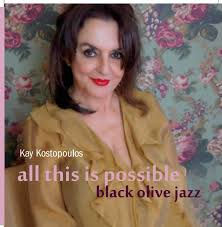
That versatility seems a natural extension of a life spent crossing artistic boundaries—as an internationally touring belly dancer, theater-trained performer and longtime Stanford educator whose career has balanced creative expression, scholarship and communication. Leading her ensemble under the name Black Olive Jazz, Kostopoulos approaches each selection not simply as a singer, but as an insightful, crafty storyteller, uncovering fresh narrative possibilities in material that spans decades, genres and traditions.
The album opens with a burst of energy on “Lover/Diggin’ for Diz,” a clever pairing of the Rodgers and Hart classic with Dizzy Gillespie’s contrafact. Kostopoulos’ soulful voice glides easily through the tune’s romantic charm before the ensemble launches into a spirited swing workout featuring exuberant saxophone exchanges, lively piano improvisations and explosive rhythmic interplay. From there, she pivots effortlessly into the intimate world of “Never Let Me Go,” revealing a more vulnerable side through understated phrasing and a sensual, smoky interplay with the saxophones. The graceful “I’m All Smiles,” from The Yearling, further showcases her gift for character and interpretive insight, balancing playful charm with subtle theatricality and rhythmic nuance.
That theatrical instinct comes fully into focus on Noel Coward’s “Mad About the Boy,” which begins with a spoken-word introduction delivered with wit, intimacy and dramatic flair before unfolding into a hauntingly reflective ballad. Elsewhere, Kostopoulos demonstrates her creative ingenuity as a lyricist. On Charlie Parker’s “Segment,” she crafts original lyrics that mirror the rhythmic vitality and inventiveness of Parker’s bebop language, engaging in a joyful dialogue with the saxophones. By contrast, her lyrical adaptation of McCoy Tyner’s “Search for Peace” offers a meditative reflection on hope, compassion and the possibility of finding tranquility amid life’s uncertainties.
Throughout the album, the singer is buoyed by an accomplished ensemble featuring the dual magic of saxophonists Noel Jewkes and Peter Brainin, pianist John DiMartino, bassist Sean Conly and drummer Vince Cherico. Whether fueling the exuberant swing numbers, engaging in spirited improvisational exchanges or adding subtle atmosphere to the album’s soulful ballads, her well-chosen musicians bring color, sophistication and a vibrant sense of conversational interplay to each performance.
Perhaps the album’s most revealing moment arrives on Rodgers and Hammerstein’s “I Enjoy Being a Girl.” Drawing subtly on her long background in dance, Kostopoulos and the ensemble infuse the tune with Middle Eastern textures, finger cymbals and hypnotic rhythmic undercurrents, transforming it into a witty, sensual and highly personal statement. The closer “More Than You Know” brings the journey to a tender conclusion, its understated arrangement allowing her warm storytelling instincts to shine.
Across just eight tracks, All This Is Possible traverses romance, humor, introspection, theatrical expression and jazz invention. What ultimately unifies this diverse repertoire is Kostopoulos herself—a true renaissance woman whose wide-ranging experiences enrich every phrase and whose commitment to unique, diverse expression gives the album its distinctive voice.
Świetny wpis. Wszystko zostało przedstawione rzeczowo i bez zbędnego komplikowania.
billboard reklamowy
Johnathan, What a lovely and thoughtful review. Greatly appreciated! All Best Wishes, Kay Kostopoulos
If anyone needs ideas for game accounts or social profiles, this name generator is worth bookmarking. I found several names that weren't overused.