


LOUIS ROSEN FINDS A NEW WAY FORWARD ON 'Life After Before'
For 42 years, Louis Rosen absorbed the sights, sounds, and restless energy of Brooklyn, a city that inevitably left its imprint on the way he experienced the world. When he and his wife exchanged its familiar urban rhythms for the slower cadence of life in the Hudson Valley, a new chapter began to unfold. Surrounded by trees, gardens, and the ever-changing moods of the seasons, Rosen found himself reconnecting with an artistic impulse that had gone silent for more than three years.
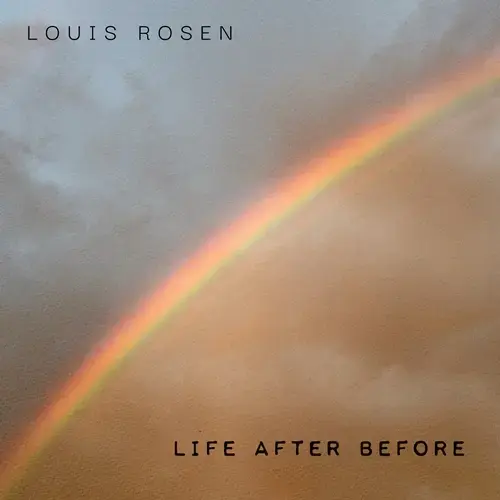
What began as a tentative reawakening soon gathered momentum, as each emerging idea seemed to illuminate the path to the next. The resulting Life After Before—his seventh solo album and 15th overall—is an intimate, deeply personal, and often haunting meditation on how the past shapes our understanding of the present and the possibilities that lie ahead. Listening to the album is a beautiful emotional experience, shaped by Rosen's thoughtful deeply human perspective on life, love and romance.
The singer’s new project follows American Sunset, his sharply observed, politically charged 2025 song cycle, which earned a place among Cadence Magazine’s Top Ten Albums of the year. The two projects could hardly be more dissimilar in atmosphere. Where American Sunset confronted the turmoil of the national moment with satire, anger, irony, and ultimately hope, Life After Before turns toward the private emotional terrain of everyday existence. Its perspective is subtler, its arrangements more spacious, and its concerns more enduring. Yet both albums share Rosen’s determination to make music that responds honestly to the world he inhabits.
“I had not written a song, music and lyrics, for over three years,” he explains. “I was composing instrumental music, orchestrating and recording, but I had not felt the impulse to write songs. I had gathered titles and lyric lines, but nothing was happening. I was beginning to wonder if I was done.”
The question was not necessarily a matter of diminishing ability. After years of composing for theater, concert ensembles, and his own recordings, Rosen had reached a point where the pressures and ambitions that once propelled him outward had begun to recede. The move also brought a slower, more contemplative rhythm, giving him space to take stock of his experiences and reconsider his priorities. The songs began arriving one after another, each seeming to open a door to the next. “It’s mysterious,” he says of the process. “You have your antenna up, and suddenly ideas start asking for your attention. The music appears, and then there’s a kind of flow. One song begets the next.”
The album’s opening statement, “Ghost of Desire,” captures that uncertain but invigorating return. A gracefully rolling acoustic guitar establishes an understated folk setting, while piano, bowed bass, and viola add layers of haunting introspection. Rosen’s weathered, soulful voice carries the lyric with a mixture of resignation and quiet resolve. The title refers to the lingering presence of ambition and creative appetite, even as the desire for familiar rewards of public recognition diminishes. Its most revealing line, “I still don’t see the point of fading out just yet,” emerged unexpectedly. “That line became the essential motivating thought of the song,” he says. “When there’s a bridge in the structure of a song, it always contains that song’s essential reason for being.”
That persistence runs through Life After Before, though Rosen rarely announces his themes directly. His songs tend to begin with an image, a phrase, a character, or an unanswered question. Sometimes he knows the story before writing a note; other times, he discovers what a song means while following the music. His background in musical theater has sharpened his attention to lyrical structure and dramatic progression, but he resists treating every composition as a miniature play.
Rosen’s creative range reflects a career that has never been confined to one musical discipline. A composer, lyricist, guitarist, pianist, author, and educator, he received a Guggenheim Foundation Music Composition Fellowship and has written for Broadway, Off-Broadway, regional theater, and the concert hall. His work includes the Tony-nominated Lincoln Center production of James Lapine’s Act One, as well as projects built around the poetry of Langston Hughes, Nikki Giovanni, and Maya Angelou. His collaborations with vocalist Capathia Jenkins produced several ambitious collections, including the three-part Black Loom Trilogy. He also wrote The South Side: The Racial Transformation of an American Neighborhood, drawing on the Chicago community where he grew up.
That breadth informs the songs without overwhelming them. Rosen began his professional life as a guitarist playing folk and folk-rock. Formal music study broadened his language, eventually leading him toward piano composition and decades of work in theater and concert music. Returning to guitar for Life After Before offered a fresh perspective.
“I wanted to return to the most primal aspect of my musical language,” he says. “I was thinking, what if I could have written an album of this quality and maturity when I was just starting out? I wanted simpler arrangements, not elaborate ones. I wanted to let the songs breathe.”

The ideal collaborator for that vision was David Mansfield, the multi-instrumentalist, composer, and producer whose career began in extraordinary fashion. At 19, Mansfield joined Bob Dylan’s Rolling Thunder Revue, later forming the Alpha Band with fellow Dylan alumni T Bone Burnett and Steven Soles. He subsequently became a founding member of Bruce Hornsby and The Range, with credits that include work with Johnny Cash, John Denver, Sting, Bobby McFerrin, and Ringo Starr. Rosen had been working with Mansfield since 2015 and knew his musical instincts and sensitivity to roots-oriented material.
For Life After Before, Mansfield served as co-producer and co-arranger, contributing acoustic and electric guitar, violin, viola, mandolin, and banjo. Rosen also brought in bassist Pete Donovan and drummer Rodney Howard. Rather than arriving at the studio with fully developed settings, he prepared basic charts and left room for the musicians to respond to the songs.
The foundation was recorded in just two days. Rosen played guitar or piano, Donovan supplied bass, and Howard handled drums, while Mansfield began inventing instrumental parts during the takes. Rosen later added planned countermelodies and vocal layers, and Mansfield returned to build additional colors into the arrangements.

“He has a deep understanding of roots and popular music, and he thrives when he’s free to make parts,” Rosen says. “I would play him the songs, and he would listen and take notes. He didn’t play anything at first. Then, when we were recording, he would come in and start inventing things. Later, at his studio, he would look at his notes, grab an instrument from the wall, and play. We never had a disagreement. It might take some back and forth to nail the polished part, but the collaboration was a pleasure. I love the way the arrangements turned out, and how the album sounds—which, by the way, is in no small part due to the great work of James Frazee, who engineered the basic tracks and mixed the album.”
“Everyone Loves the Wrong Someone” introduces a more buoyant, pop-oriented pulse. Its acoustic strumming and steady drum groove initially suggest a familiar romantic dilemma, with a brief electric-guitar passage adding crackle to the production. But Rosen has a distinct destination in mind. He had carried the title for five years without finding a way to turn it into a song. The breakthrough came when he reversed its apparent premise: rather than lamenting romantic mistakes, he realized he had been fortunate enough to love the right person at the right time. The result turns disappointment into an unexpectedly warm celebration of serendipity.
“The Rhythm of the Road” shifts the focus to travel, movement, and the desire to escape daily demands. An elegant piano figure, echoed by electric guitar, gives the song a reflective, almost cinematic quality. Rosen’s vocal unfolds over an expanding rhythm section, while the lyrics suggest that the open road can offer temporary release from the noise of the news and the weight of routine. A subtle harmonic turn adds whimsy to its thoughtful mood.
“45 Minutes to Somewhere” has a more buoyant feel, beginning with piano before settling into a relaxed guitar-driven groove. Its premise came from conversations with people in the Hudson Valley who would ask whether Rosen lived near a particular town. His standard response was that it was about 45 minutes away. The phrase eventually became a lyric and a portrait of a man trapped in the repetitive patterns of a life he has occupied for decades. A distant train whistle suggests the possibility of escape, though Rosen deliberately leaves the outcome unresolved. “It’s a character song,” he says. “The man has been in the same town for 45 years. He’s living the same life, day after day, and there’s a train in the distance. We don’t know if he gets on it.”
The lyric’s more sobering observations are balanced by offbeat humor, particularly its recurring references to drinking too much malt after midnight. The central refrain—“45 minutes to any other place but here”—becomes both a geographical observation and an expression of inner disquiet.
The title track approaches memory and identity through a dreamlike lens. Rosen imagined himself walking through an unfamiliar place when he noticed a handwritten wooden sign in the window of an old corner store. The words were “Life After Before.” He woke with the phrase and eventually built a song around it, allowing the title to remain an open question rather than an explanation.
The stately acoustic introduction, interwoven guitar lines, and haunting violin establish a contemplative atmosphere. Its narrator encounters the mysterious sign and wonders what it might mean. The phrase became even more significant after Rosen played the song for his students. One told him it reminded her not to remain absorbed in the past or in the people she had lost, but to live fully in the present. She described her present as her “life after before.”
“That really moved me,” Rosen says. “I had originally been thinking of calling the album Ghost of Desire, but after that conversation, I changed the title. I think the phrase can mean different things to people. It asks a question, but it doesn’t answer it.”
Memory becomes more concrete in “Didi White,” a softly fingerpicked whose intertwined guitars, mandolin, and delicate descending figures evoke the chill of a Chicago winter. The song is a fictional composite, drawing on Rosen’s recollections of two women he briefly knew in his youth. A chance encounter with a familiar actress on television years later prompted him to look her up and discover that she had recently died. The memory resurfaced in fragments, eventually becoming a portrait of a woman whose personality was as compelling as it was unpredictable.
The lyric’s description of a woman who “will bruise you with a smile / Then choose you with her heart” captures the contradiction at the center of the song: a fleeting encounter that somehow remains vivid decades later. The Chicago setting adds another layer of specificity, not as nostalgia for its own sake but as the inner landscape of a memory that has never entirely disappeared.

“The Arrow and the Bow” offers a piano-centered reflection on finding love. Its spare accompaniment and understated electric-guitar accents create a gentle sense of forward movement, while vocal harmonies add warmth. On “Do You Think of Me?,” Rosen turns to a more ambiguous romantic exchange. At first, the lyric sounds like a breakup conversation, but its progression eventually suggests a proposal or the renewal of vows. Intertwined steel-string guitars, delicate piano figures, sparse bass, and cymbal accents create a sensual, suspended quality. Rosen particularly likes the way the guitars seem to converse, while the piano and vocal echoes deepen the sense of an internal dialogue.
“Candice and Me” brings the album’s private and personal dimensions together. The garden outside Rosen’s new studio window is the literal setting behind the song, a private refuge amid the complications of contemporary life. Its gentle acoustic pattern and understated string colors make the piece feel almost meditative. The song also marks a shift in the album’s narrative arc, from the search for connection toward the recognition of love already present. Rosen had recorded an earlier version for American Sunset, but believes Mansfield’s acoustic-guitar countermelody and viola bring this arrangement into sharper focus.
The album closes with “Straight, True Love,” perhaps its most direct and emotionally vulnerable statement. Inspired by his father’s unconditional love, the song considers how affection and generosity pass from one generation to another. Its simple folk structure, violin, banjo, and interlocking acoustic guitars give it the quality of a song that might have existed for generations. Mansfield affectionately described it as “porch music,” imagining a group gathered together, each joining in the melody.
“It’s a very simple song about my father and his remarkable, unconditional love,” Rosen says. “It’s about the continuum of love, how love begets love, and how it’s our responsibility to pass it on. I was worried that the song might be too sentimental, but I felt that if we could make it direct and honest, it would work. If we overproduced it, we would kill it.”
Rosen has spent much of his career exploring music’s capacity to communicate complex ideas, whether through theatrical narratives, literary collaborations, concert compositions, or the pointed social observations of American Sunset. On Life After Before, he finds a more unguarded and vulnerable kind of expressive freedom in the intimacy of folk songwriting. The result is not a retreat from the world, but a closer examination of the human experiences that give it meaning.
“I hope listeners are moved emotionally in different ways, that the lyrics are stimulating, the music is satisfying and surprising, and that people appreciate the arc of the album and want to listen again,” he says. “This album just might make people feel good.”
And for an artist who had begun to wonder whether his songwriting days were behind him, that may be the most meaningful discovery of all.
Comments