


Q&A WITH DAN WHEETMAN of MARLEY'S GHOST
Updated: Apr 18
Often associated with the Pacific Northwest but never confined to a single geographic identity, Marley’s Ghost has, over four decades, carved out a singular place in the American roots music landscape through its seamless blend of folk, country, bluegrass, gospel and beyond. Rather than being rooted in a single city, the band reflects the wide-open spirit of the American West itself—a collective shaped by decades of life and music-making across Washington, California, Montana and beyond. Though the members are now geographically scattered, their connection has only deepened over time, forged through years of shared stages, road miles and a common musical language. If anything, that physical distance has strengthened their sense of purpose, allowing each player to bring a distinct regional and personal perspective into a sound that remains remarkably unified.

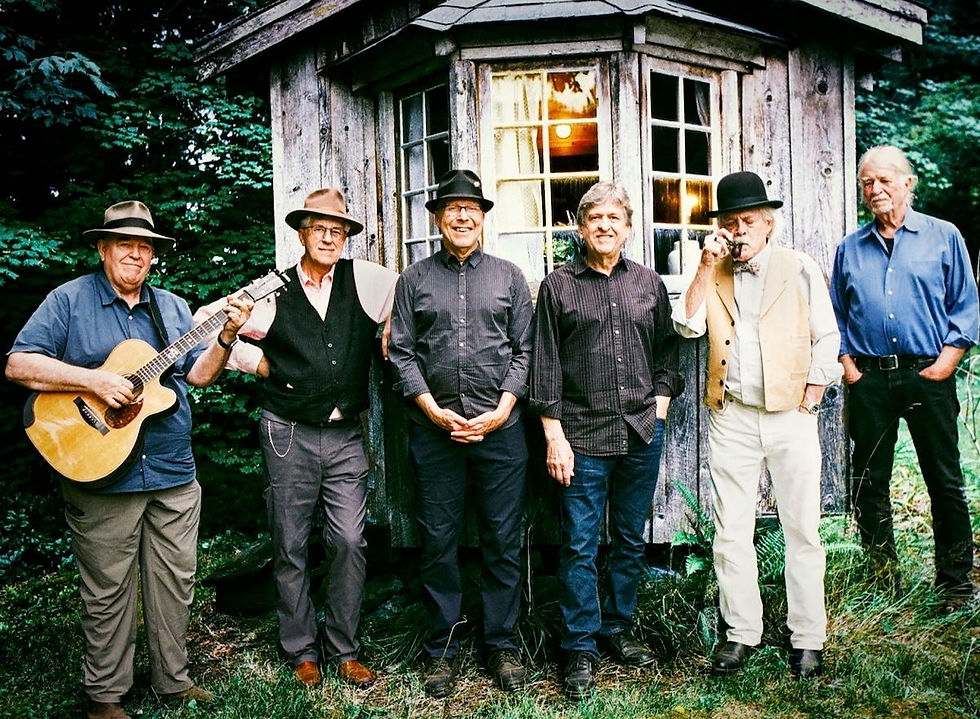
Central to that enduring identity is the intuitive chemistry between its six core members—multi-instrumentalists and vocalists Dan Wheetman, Jon Wilcox, Mike Phelan, Ed Littlefield Jr. and Jerry Fletcher, along with drummer Bob Nichols. Each brings a distinct musical background, yet what defines Marley’s Ghost is how seamlessly those voices have merged over the decades into a unified whole. It’s the kind of cohesion that can’t be manufactured or rushed—it’s earned over years of playing together, recording independently, navigating creative differences, and learning how to listen as deeply and intuitively as they perform.
As they celebrate their 40th anniversary, Marley’s Ghost returns with Honky Tonk, their first album in seven years—a thoughtful, high-spirited, deeply felt collection of classic country tunes made famous by legends like Hank Williams, Merle Haggard, Waylon Jennings and George Jones. Produced once again by the legendary Larry Campbell (Bob Dylan, Levon Helm) the album reflects both the band’s deep roots in this music and their ongoing evolution as interpreters and storytellers. Rather than simply revisiting familiar material, the band approaches these songs as living, breathing works—finding fresh emotional angles while honoring the spirit that made them timeless in the first place.
Drawing on decades of shared experience—from barrooms and festival stages to studio collaborations with icons—the band approaches this material not as revivalists, but as lifelong participants in the tradition. In this conversation, Dan Wheetman reflects on the band’s longevity, creative philosophy, the emotional core of roots music, and the almost spiritual force that continues to carry them forward after forty years.
You’ve all played together for decades, and that kind of longevity is rare. What’s allowed Marley’s Ghost to not only stay together, but keep evolving?
WHEETMAN: A big part of it is that we cover so many different genres. We’re not just one thing—we’ve done reggae, country, gospel, old-time, bluegrass—and that variety keeps things fresh. It gives us the freedom to move between styles and not feel boxed in, and that alone keeps the creative energy alive. There’s always another direction to explore, another way to interpret something.
But beyond the music, it really comes down to relationships. When you stay together that long, you inevitably go through phases. I always say it’s like a marriage—you meet and everything is exciting, you’re dancing in the park and loving every second. Then later on, the little habits start to wear on you. But if you can get through that stage—if you can learn not to take things personally—you come out the other side with something much deeper than that initial spark.
What makes it work for us is that the focus is always on the collective. It’s never about one person’s creative flow dominating everything. If someone brings in an idea, we try it. We don’t dismiss it out of hand. That openness allows the music to grow in ways none of us could have planned individually. Some of our best moments have come from stepping outside our own instincts and trusting the group.
How has the band dynamic evolved over time—and what’s stayed the same?
WHEETMAN: There’s been a lot of evolution, but there’s also been a strong through-line. Early on, it was just the four of us, and as we started recording more seriously, we brought in additional players. Jerry Fletcher, for example, started as a drummer but turned out to be a fantastic piano player, so for a while he was doing both—which was pretty incredible to watch. Eventually, we brought in Bob Nichols as a dedicated drummer, and that opened things up even more musically.
With each addition, the arrangements changed. More voices mean more ideas, more textures, more possibilities. That can take you in different directions—some stronger than others—but that’s part of the process. You don’t always know where something will lead until you follow it. What hasn’t changed is the intention behind what we do. We’re always trying to get to the truth of a song. Even a honky tonk tune—something that might seem simple on the surface—has a real emotional core. As a singer, you have to step into that. It’s like acting. For those few minutes, you’re inhabiting a character, telling their story, and making it believable. That mindset has been there from the beginning.
What drew you to the honky tonk concept for this new album at this stage of your career?
WHEETMAN: It came out of a combination of things. Working with Larry Campbell has been a huge part of our growth over the last few albums. He has such deep musical knowledge, and he’s always pushing us—encouraging us to go further, to refine things, to really dig into what we’re doing.
At the same time, honky tonk is something we all know intimately. It’s not something we had to study—it’s something we have all lived. Jerry and I played those rooms in Colorado, Eddie did similar gigs in the Northwest—this is music we’ve played night after night. It’s in our bones. So when the idea came up, it felt completely natural. We’ve done themed albums before—gospel, old-time—and this felt like the next chapter. Setting that loose boundary around pre-1970 material helped give it focus, but really it was about reconnecting with something that’s always been part of who we are.

After 40 years, what still keeps the process fresh and inspiring?
WHEETMAN: The music itself. That’s really the simplest and most honest answer. Music comes from somewhere beyond you—it’s inspiration, it’s the muse. There are moments when you’re playing where you’re aware of what you’re doing, but at the same time, something else is happening. You’re being carried along by it. That feeling is incredibly powerful—and addictive in a good way. It keeps you coming back. It keeps you curious. When something becomes more than just a job—when it’s something that feeds you creatively and emotionally—it doesn’t get old. You might change, your perspective might change, but the connection to the music stays vital.
How did you choose which songs made the cut for Honky Tonk?
WHEETMAN: We started with a pretty big pool of songs and begin working through them, and it becomes clear pretty quickly what’s working. There’s a certain energy when something clicks—it feels right, and everyone in the band can sense it. At the same time, we were thinking about the overall shape of the album. How do the songs sit next to each other? What kind of journey does it create for the listener? But the most important thing is that emotional connection. If you don’t feel like you belong inside the song—if you’re not invested in it—it’s probably not going to make the record.
Your versions never feel like replicas. How do you reinterpret these classics while honoring them?
WHEETMAN: There are really two ways to approach a cover. One is to replicate it because the original is so iconic. The other is to let it evolve naturally through the band—and that’s usually what we do. Once we start playing something together, it begins to change. Someone might suggest a harmony, or we might swap instruments—use a dobro instead of a guitar, for example—and suddenly it takes on a different personality. That’s how it becomes ours. We’re not trying to reinvent for the sake of it—we’re just letting it become what it wants to be in our hands.
How do you define what you do, especially with a term like “Americana”?
WHEETMAN: For a long time, that term didn’t really help us because people didn’t know where to place us. Now it actually works in our favor because it’s such a wide umbrella. At the core, though, we’re a vocal band. Everything is built around the singing—the harmonies, the storytelling. The instruments support that. And beyond labels, it’s really about being true to the music. There’s no guarantee in chasing success, but there’s something very real in staying true to what you love. That’s always been our guiding principle.
What role does roots music play today compared to when you started?
WHEETMAN: I think it’s more important now than it was when we started. There’s a real hunger for authenticity. People are looking for something that feels grounded, something that speaks to real experience. We’re seeing younger audiences come to this music in new ways—through festivals, through crossover artists—and once they hear it, it resonates. There’s something timeless about it. Roots music has always been about telling the truth—about life, about struggle, about joy. And I think people need that now more than ever.
What were the recording sessions like for this album?
WHEETMAN: We recorded live, sitting in a circle, playing together. That’s the key to the feel of the record. When you’re all in the same room, reacting to each other in real time, there’s an energy that happens—you’re feeding off each other, pushing and pulling in subtle ways. That’s hard to recreate when everything is done in pieces. We wanted that immediacy—that sense that the music is happening right now.
What does Larry Campbell bring as a producer?
WHEETMAN: He brings a deep understanding of the music and a respect for what we do. He hears things we might not hear, and he pushes us to go further, but he’s not heavy-handed. He’s collaborative, open, and incredibly musical. That makes him a great fit for us.
What does “honky tonk” mean to you personally?
WHEETMAN: It’s very personal. My mom was from Oklahoma, and that music was part of my upbringing. Honky tonk is really about people—working hard, going out to dance, letting off steam. It’s social music. It’s participatory. But it’s also storytelling. It’s about real lives—sometimes joyful, sometimes full of heartbreak. That’s what gives it its depth.
How have your wide-ranging influences shaped this project?
WHEETMAN: Everyone in the band has a broad background—bluegrass, rock, old-time, country—and all of that feeds into what we do.You can’t hear different kinds of music and not be affected by them. Whether you embrace it or not, it shapes your voice. All of those influences are in there, even when we’re playing something very traditional.
As you celebrate 40 years, what does this milestone mean—and what do you hope listeners take away?
WHEETMAN: Looking back, it hasn’t always been easy, but it’s always been about the music. That’s what’s carried us through everything. At this point, it feels like a time to celebrate that—to appreciate the journey and where we are now. What I hope people take away is the joy of it. A song means something different to everyone, but if someone hears something that connects with them on a human level, then we’ve done what we set out to do.
Comments