

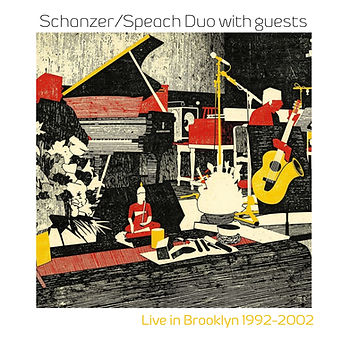
SCHANZER/SPEACH DUO with GUESTS: Live in Brooklyn 1992-2002
The most exciting musical discoveries often happen when accomplished artists abandon familiar structures and plunge into the exhilarating unknown, listening, responding, challenging one another, and uncovering melodic possibilities that could never emerge from a strictly scripted performance. That spirit of fearless exploration courses through Live in Brooklyn, 1992–2002, a fascinating double-CD collection documenting guitarist Jeffrey Schanzer and pianist/composer Bernadette Speach in collaboration with an extraordinary assortment of creative music pioneers.
Spanning a decade of performances, these ten tracks celebrate improvisation as a living art form, where intricate fingerstyle guitar passages, percussive piano explorations, expressive horns, and unexpected musical revelations converge in constantly evolving conversations. Sometimes meditative and achingly beautiful, sometimes fiercely dissonant and gloriously unruly, these performances reveal musicians who understand that spontaneity can be a powerful catalyst for creativity.
Schanzer and Speach began their partnership in Buffalo, New York, in 1982, combining contrasting but complementary backgrounds in jazz, global traditions, contemporary classical composition, and experimental improvisation. Speach studied composition with avant-garde pioneer Morton Feldman, while Schanzer developed an expansive vocabulary encompassing jazz, world music, and exploratory guitar techniques.
After relocating to Brooklyn in 1984, they became instrumental in nurturing an artist-driven creative community. Schanzer served as president of the Musicians of Brooklyn Initiative (MOBI), founded by Lester Bowie, Oliver Lake, and Cecil Taylor, while Speach worked as a producer and concert organizer. Following MOBI’s closure, the couple co-founded MusicVistas, Inc., presenting concerts at Lafayette Presbyterian Church and the Brooklyn Society for Ethical Culture. This collection preserves the adventurous spirit of those gatherings, when artistic independence and grassroots collaboration sustained a remarkably fertile musical environment.
The opening Improvisation, featuring alto saxophonist Oliver Lake, immediately establishes the duo’s distinctive approach. High-register piano plucks and resonant acoustic guitar strums exchange ideas with playful precision before Lake introduces a breathy, soulful saxophone voice that plunges into dark, foghorn-like declarations and piercing upper-register bursts. Speach answers with rumbling chords, glissandos, and emphatic attacks, while Schanzer counters the chaos with nimble fingerstyle passages and increasingly assertive jazz guitar licks. The three musicians alternately collide and connect in a fascinating display of instinctive communication. Just when the dense interplay threatens to overwhelm the tuneful thread, Schanzer emerges with a fluid, lyrical guitar passage, offering a glimmer of clarity amid the surrounding frenzy. It’s a riveting introduction to an album where unpredictability becomes expressive freedom.

Lester Bowie brings a different emotional dimension to The Villager. Graceful piano and gently strummed guitar establish the atmosphere of an intimate jazz ballad before Bowie’s warm, breathy trumpet enters with a searching, almost mournful melody. The musicians gradually introduce tension through sharper keyboard figures and animated guitar textures, while Bowie responds with expressive runs and impassioned wails. This movement between serenity and intensity makes the performance especially affecting, with the musicians repeatedly rediscovering the composition’s tender harmonious foundation.
Percussionist and Drumfolk Riddim specialist Dr. David Pleasant transforms the next Improvisation into a rhythmic adventure. Schanzer establishes a taut guitar motif as Pleasant layers hand-played percussion, resonant strikes, and rattling textures over the increasingly animated exchange. Speach’s explosive piano flourishes mingle with Pleasant’s airy, birdlike flute, evoking an imaginary woodland soundscape. Organic percussion, textured guitar figures, and darting piano gestures create an almost theatrical sense of movement. Schanzer’s expansive jazz guitar solo provides a lyrical anchor before the flute returns and the music erupts into a celebratory, rhythmically infectious finale.
One of the album’s most ambitious statements is Wadada Leo Smith’s 24-minute Rain Flowers, Vertical Spears and Diamond Sunrays. Smith brings diverse instrumental palette, including koto, trumpet, mbira, harmonica, and wooden flute, while Speach adds toy piano to the duo’s customary guitar-and-piano interplay. The koto’s metallic resonance establishes an exotic counterpoint to Schanzer’s understated guitar, while the toy piano introduces delicate, almost childlike tones. As the piece unfolds, mysterious low-register piano figures, haunting flute passages, and Smith’s soulful trumpet continually transform the soundscape. Schanzer’s expressive guitar provides a mellifluous thread through these shifting textures, while Speach alternates delicate high-register touches with darker, emphatic chords. Smith’s instrumental versatility keeps the conversation fresh, making this sprawling exploration a compelling study in contrasting colors, moods, and impromptu invention.
Mark Dresser’s double bass takes the final Improvisation on the first disc into darker territory. Ambient hiss and heavy percussive strikes establish a stark atmosphere before Dresser’s resonant bass notes emerge alongside Schanzer’s sharply articulated guitar and Speach’s restless piano. Sustained tones alternate with sudden flurries of activity, creating a tense, cathartic exchange. Schanzer’s agile jazz phrasing offers flashes of melodic definition, but the rumbling bass and forceful rhythmic collisions dominate this thrillingly unruly performance.
The second disc opens with another Improvisation, featuring Bowie and cellist Fred Lonberg-Holm. The cellist’s guttural, almost human-sounding tones establish an ominous foundation against which Bowie’s trumpet offers unexpected radiance. Schanzer and Speach respond with clipped guitar phrases and emphatic piano figures, intensifying the tension beneath Bowie’s expressive trumpet. The contrast between the cello’s shadowy resonance and Bowie’s resonant warmth creates a captivating balance of tension and release.

Alva Rogers provides one of the collection’s most distinctive departures with Foreign Affair, a dramatic spoken-word and vocal performance. Gentle guitar and flowing piano establish an intimate atmosphere before Rogers narrates an encounter between two strangers, moving fluidly between speech and song. Her elongated phrases and theatrical inflections transform the piece into something resembling an improvised chamber musical. Schanzer and Speach respond with increasingly animated interludes, using harmonic shifts and rising tension to heighten the unfolding narrative.
Rogers’ expressive delivery makes this one of the album’s most immediately engaging performances.
Violinist Leroy Jenkins brings volatile energy to the subsequent Improvisation. His darting, sometimes abrasive lines weave through Schanzer’s sharply articulated guitar figures and Speach’s emphatic piano clusters, producing an exhilarating collision of textures. The violin alternates between lyrical flourishes and intensely percussive gestures, while the duo maintains a restless rhythmic dialogue.
On Glove Quartet, soprano saxophonist Holland Hopson and electronics artist John J.A. Jannone push the music into even more adventurous territory. Forceful piano attacks, dense percussion, and abrasive electronic textures gradually give way to more spacious passages. Hopson’s expressive saxophone and Schanzer’s fluid jazz guitar emerge from the sonic upheaval, demonstrating how even the most challenging explorations can yield moments of striking clarity.
The collection concludes with Joseph Jarman’s expansive Hollows Five: II – Sincere Words. Can’t Compromise or Overpower, a 22-minute performance featuring alto saxophone, flute, percussion, piano, and guitar. Delicately resonating chimes establish a meditative atmosphere before Speach introduces a gently unfolding piano motif and Jarman’s breathy saxophone adds a darker, almost vocal quality. Schanzer gradually assumes the spotlight with a dazzling fingerstyle passage whose fluidity and occasional flamenco-like inflections provide one of the album’s most memorable highlights. Exotic percussion and Jarman’s floating flute lines further enrich this expansive finale, balancing contemplative beauty with adventurous instrumental interplay.
Ultimately, Live in Brooklyn, 1992–2002 preserves more than a remarkable series of performances. It documents an artist-driven community in which adventurous musicians could meet, experiment, and develop ideas beyond conventional commercial expectations. Schanzer and Speach emerge as both formidable musical partners and committed cultural catalysts, creating the conditions for collaborators as distinctive as Bowie, Lake, Smith, and Jarman to bring their individual voices into the mix. The result is an absorbing portrait of Brooklyn’s experimental music scene, alive with the creative energy of artists who understood that musical discovery was as much about listening to one another as it was about taking risks.
Comments