


THE JAY D'AMICO JAZZ ENSEMBLE, Ponte Novello
Updated: Jan 5
Over the last 25+ years, veteran New York pianist/composer Jay D’Amico has set a fascinating standard that sets him apart from all other jazz-based recording artists, finding ways to artfully and engagingly fuse the two great loves of his musical life - European classical arias and American improvisational jazz. Whether performing with a trio, duo with bass or larger jazz ensemble, he’s rooted those passions in a fascinating, heritage-based curation and exploration of Italian music and places on the map and in his heart.
Among his works that have brought the full force of all this creativity to bear are the 2008 trio album Tuscan Prelude, Melodia (2024) and most recently, Ginevra: a portrait of little girl blue (2025), a collection featuring a new trio (that includes his bassist brother Greg D’Amico) inspired by Da Vinci’s late 1470’s painting Ginevra de Benci.
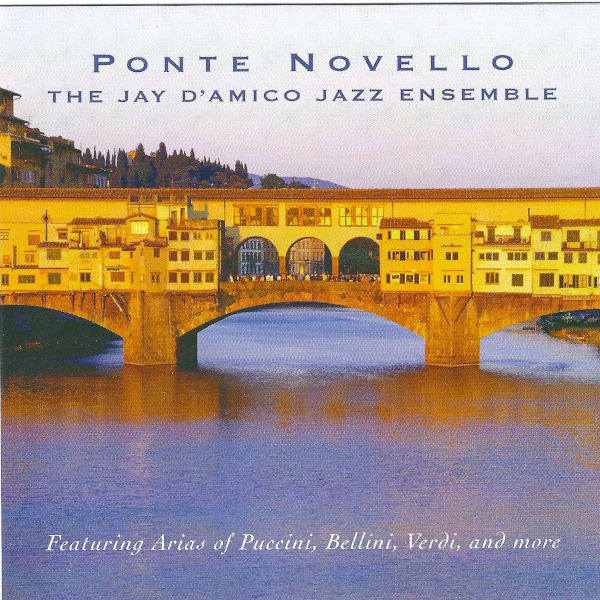
Released in 1999, Ponte Novello, D’Amico’s extraordinary, trio and string section driven set featuring contemporary interpretations of pieces by Puccini, Bellini and Verdi, was not his debut album. It came out some 17 years after his first recording Envisage and nine years after From the Top, a solo piano album of standards and originals reflecting his years of performances at Windows of the World atop the North Tower of the World Trade Center. Yet the collection feels like a debut of sorts in that it was the first to solidify what became his trademark hybrid style.
In his brief but insightful liner notes to the richly elegant, gracefully soulful yet often intensely spirited and rhythmically vibrant repertoire, D’Amico writes, “Both of these musical forms have always been deep sources of inspiration and they are part of my earliest musical memories.” Not surprisingly, he adds that the conception of the project began in Italy in the company of family and close friends, listening to arias by the great Luciano Pavarotti. He immediately felt inspired to work on a fresh piano arrangement of “E Lucevan Le Stelle” from Act 3 of Puccini’s Tosca, first performed in Rome in 1900.
True to its title, the overriding message of Ponte Novello is “new bridge,” a bridge between the two styles. Renaming the Ponte Vecchi (old bridge) Ponte Novello was a way for D’Amico to deliver that message without using an actual title tune. For the curious, the name came about when D’Amico and his brother were in Italy trying to come up with the perfect title. They wanted to use the word “nuovo,” the original word for new in Italian – but they didn’t like the way Ponte Nuovo sounded. Hanging at one of their go-to wine bars, they spotted a bottle marked Novello, which refers to young or new wine. They asked some native Italian friends and found out it would be acceptable to use in this context. Ponte Novello was born!
As listeners dive into the fascinating repertoire, enjoying D’Amico and company’s delightfully dizzy dance between string-tinged classical grandeur and funkified, freewheeling improvisation fired arrangements, they should know a bit about his ultimate creative intentions with this music. “It’s absolutely not about getting European music to swing,” he says. “It was about my personal conception. I knew that for the first time, I was able to combine my melodic thinking and phrasing with the completely different rhythmic concept of American music. It was my intention to combine two musical loves, something that always frustrated me.
“The story is all about the bel canto (beautiful singing) and how I’m trying to get the instrumental music to sing,” he adds. “I felt the arias selected lent themselves to this new style I was trying to create for myself, keeping in mind that Chopin was inspired by the Italian Opera and Vincenzo Bellini was his favorite.”
Following D’Amico’s lush, dynamics filled multi-faceted original opening piece “Preludio” (purposed like a prelude to an opera program), which eases from a haunting chamber like intro into a high spirited, playfully swinging and improv filled trio romp – the pianist sets the tone for the album with his imaginative, whimsy filled take on “E Lucevan…,” which begins with staid eloquence before the late Ben Brown’s snappy bass and Ronnie Zito’s subtle, then snazzy groove pops in to transform the piece into a rambunctious and festive classical-jazz romp. “The protagonist Cavaradossi is in his jail cell and is scheduled to be shot at dawn,” D’Amico says. “While seeing the stars shining from his cell, he sings this incredible aria.”
After a lighthearted, infectiously charming breeze through “Musetta’s Waltz,” a soprano aria from La bohème, D’Amico wraps the first stirring Puccini segment of Ponte Novello with a rendition of the eternally gorgeous “Nessum Dorma” (from Turandot) that begins with a caressing orchestral flair before evolving into a spritely skipping energy and wrapping with a chamber music solemnity. Though D’Amico says he “held up the orchestra with applause and cheering after Pavoratti sang this,” it’s well known to pop audiences due to Aretha Franklin’s 1998 Grammy performance and recent live performances by Jennifer Hudson.

There are many highlights on Ponte Novello beyond this, from D’Amico’s wild, fast rolling improv-rich fairy dustings of two other Puccini gems (“Che Gelida Manina” also from La bohème, “Non Piangere Liu” from Turandot) to a laid back stroll through “Casta Diva” (from Bellini’s Norma) that bursts into a romp midway through. D’Amico chose to tackle the wonderful melodies of Verdi’s “Un Ballo in Maschera” (Themes 1 and II) because the opera was Pavarotti’s favorite to perform and the tenor mentioned in his book that it had such great variety for him. The exciting one two punch from this opera allows D’Amico to play with sweetness, grace and a touch of lilting “grazioso” (on Theme 1) and bolder, more emphatic improvisational fireworks (on Theme 2).
D’Amico had planned to have his mentor Milt Hinton on bass for the last Neopolitan track, the charming, lightly shuffling waltz “Non Ti Scordar Di Me” (a famous Italian film song by Ernesto de Curtis from 1935), but “The Judge” (aka the “Dean of American Jazz Bass Players”) was not well enough at the time. (Ben Brown did an incredible, supple job on this one, of course!)
So the pianist chose to bookend the set with his previously recorded original, the effervescent, heartfelt “Alfreda,” which featured him. Hinton gave D’Amico a hearty thumbs up after hearing the whole album saying he loved it and telling his protégé, “You found your niche!” A quarter- century after the bassist’s passing, D’Amico is still finding, defining and redefining that niche, to the delight of jazz fans everywhere!
Comments