


TOM C. REED, From the Basement Pipes

While some artists present their songs—their creative children—as finished statements reflecting specific moments in their lives, Tom C. Reed approaches them as evolving ideas, living, breathing structures shaped as much by instinct, experimentation and revision as by melody and lyric. On his quirkily titled collection From the Basement Pipes, the veteran singer/songwriter continues a creative journey that’s been decades in the making, defined less by linear momentum than by persistence, curiosity and a willingness to follow where each musical impulse leads.
A follow-up to his debut First Impression…Finally!, the album deepens Reed’s identity as a composer-thinker—an artist who builds from the inside out. His songs don’t simply arrive; they unfold—often pivoting between tempos, textures and moods within a single piece, revealing their direction gradually rather than locking into a fixed form. Drawing from a wide palette that includes classic rock, progressive textures, jazz phrasing and soul-inflected grooves, Reed creates a singular aesthetic that feels both referential and distinctly his own.

The expansive yet immediately infectious lead single “Let’s Make It So” sets the tone with a buoyant blend of retro keys, electric guitar and brassy accents that suggest a loose, playful intersection of Bowie-esque theatricality and Steely Dan sophistication—perfectly in line with one enthusiastic fan’s assessment of his coolly idiosyncratic vocal style. Beneath its strutting groove lies a deeper thematic thread—questions of belonging, timing and emotional risk. Reed’s vocal moves fluidly between introspection and urgency as he circles the central idea of possibility, returning to the refrain like someone trying to will a moment into permanence.

That balance between uncertainty and forward motion runs throughout the richly immersive nine-track album. On “Listless,” a slow-burning, blues-tinged meditation built on electric piano and shifting textures, Reed leans into a more abstract lyrical space. The song drifts deliberately, mirroring the unsettled soul terrain it explores. As horns and rhythmic elements gradually emerge, the track evolves from introspective haze into something more rhythmically grounded, reflecting the push and pull between inertia and engagement.

Reed’s compositional instincts are perhaps most vivid on “From Single to Dingle,” a dreamlike, Irish-tinged piece inspired by a personal travel memory yet shaped into something more impressionistic. Infused with a gentle Irish folk undercurrent and a blend of piano, violin, flute and acoustic textures, its lilting 6/8 feel and windswept melodic arc evoke a sense of place as much as narrative, unfolding like a musical vignette. The melody rises and falls with natural fluidity, reinforcing Reed’s tendency to favor vertical, exploratory movement over predictable phrasing.
Elsewhere, he leans more directly into groove-driven structures. “Together” rides a mid-tempo, horn-infused pulse that feels both grounded and expansive, its lyrics tracing the fragile, hopeful beginnings of connection. The arrangement shifts subtly between sections, allowing Reed to explore variations on a central theme rather than locking into a single tonal approach.

That same structural curiosity fuels “The OCF Brigade (Obnoxious Calamitous Fear),” one of the album’s more conceptually pointed pieces. Built around a jangling piano figure and punctuated by handclaps and layered vocal textures, the track offers a lightly satirical take on anxiety and self-doubt. Reed balances philosophical observation with a sense of play, allowing the music to carry an undercurrent of buoyancy even as the lyrics examine the persistence of irrational fears.

“Stretch” takes a more direct motivational turn, driven by dynamic shifts between restrained, contemplative passages and horn-powered bursts of energy. The repeated refrain—“Stretch or doubt will pull you in”—feels less like a philosophical mantra than a hard-earned realization, reinforced by the song’s constant movement between tension and release. It’s one of several moments where Reed’s long personal and musical journey comes into sharper focus.

Romantic ambiguity and restraint define “Porcelain Doll,” a mid-tempo ballad that blends gentle piano, subtle rhythmic motion and layered vocal textures. The lyrics hover between desire and hesitation, capturing the internal negotiations of an unspoken connection. Reed resists resolution, allowing the song to linger in its own uncertainty.

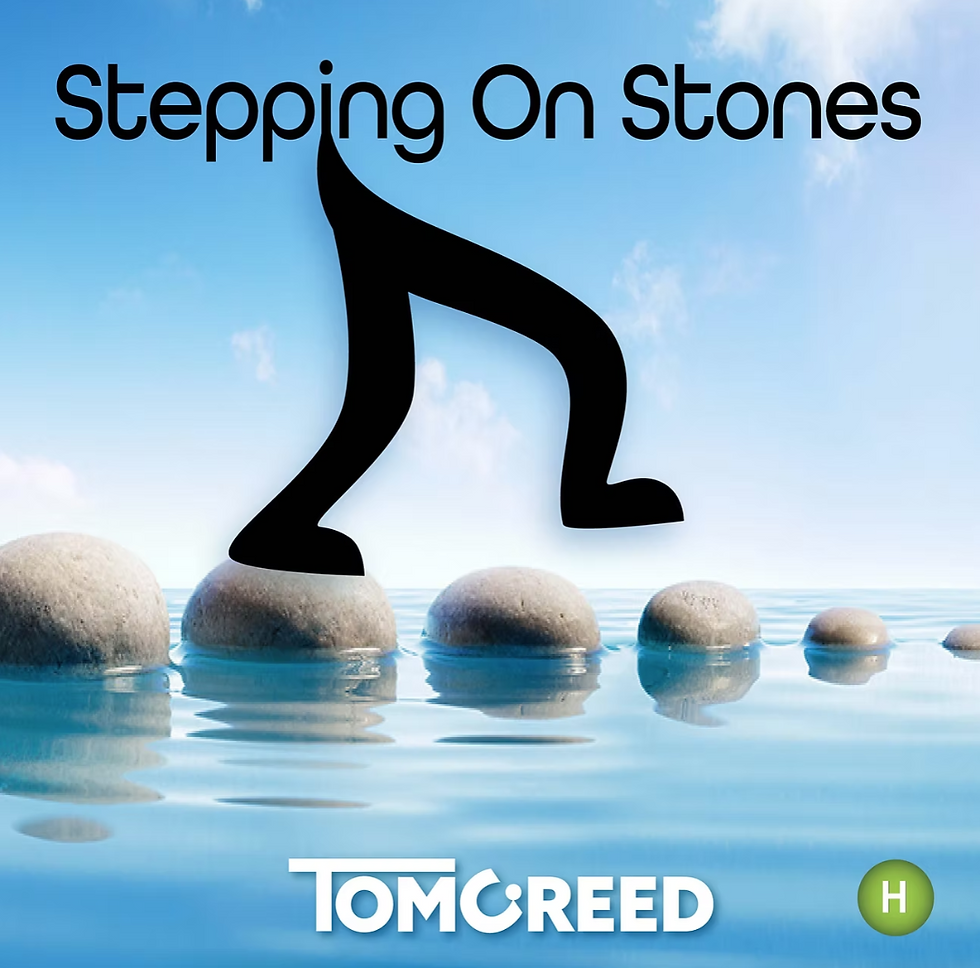
The album’s conceptual core may lie in “Stepping on Stones,” a blues-inflected rocker rooted in lived experience. With its mix of melodic introspection and surging instrumental energy, the track explores themes of perseverance, disillusionment and self-reliance. Reed’s vocal performance here is particularly expressive, shifting from near-whisper to full-bodied declaration as he works through the song’s emotional terrain.
Closing with the expansive “Ways of Days,” Reed turns toward broader reflections on time, momentum and personal philosophy. Anchored by a hypnotic groove and layered with evolving textures, the track feels less like a conclusion than a continuation—an open-ended meditation on movement and meaning.

Throughout From the Basement Pipes, Reed’s strength lies not in polish for its own sake, but in his willingness to let songs remain flexible, responsive and alive. His approach favors discovery over certainty, embracing unexpected turns in harmony, rhythm and poetic musings. The result is a collection that resists easy categorization, unified less by style than by a consistent creative mindset.
In that sense, From the Basement Pipes is not simply a set of songs—it’s a document of process, capturing a mature, distinctive artist who continues to refine, question and expand his musical language. Reed doesn’t just present his work; he invites listeners into the act of shaping it, one idea at a time. His stories may take a few listens to fully reveal themselves, but the vibrant rock/blues energy, brassy interplay and dynamic tempo shifts keep the experience continually engaging – and endlessly intriguing.
“I’m always searching for something unexpected—a chord, a melodic turn, a rhythm that feels just a little different,” Reed says. “Sometimes it’s an accident, sometimes it’s instinct. But the goal is always the same—to find something that feels alive, something that connects. I don’t always know where a song is going when I start. I just follow it and see what reveals itself along the way.”
There are many uncertainties, but I still have absolute faith in slope run