


DAVID FELDER, Les Quatre Temps Cardinaux (The Four Cardinal Times)
Time rarely behaves as neatly as the clock suggests. Memory folds yesterday into today, moments of extraordinary brightness emerge from periods of uncertainty, and the closing of one chapter can unexpectedly become the beginning of another. Composer David Felder explores these shifting dimensions of human experience in Les Quatre Temps Cardinaux (The Four Cardinal Times), an ambitious, 50-minute fusion of contemporary orchestral music, operatic performance, spoken poetry and multichannel electronics.
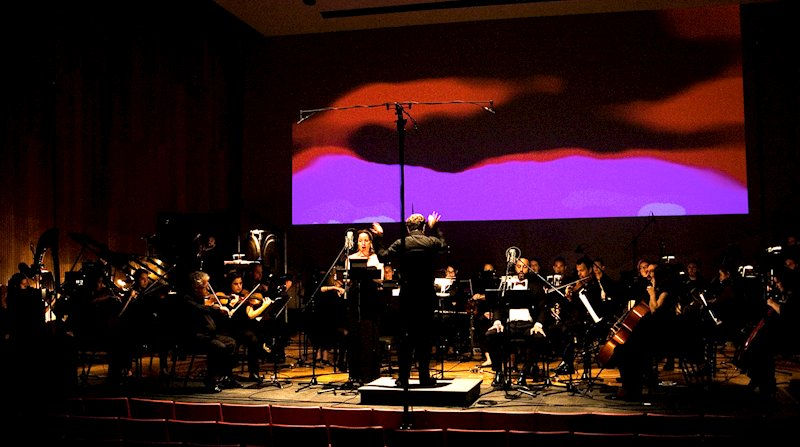
Performed by Ensemble Signal and members of the Slee Sinfonietta under conductor Brad Lubman, the work is an unusually theatrical listening experience, at once cerebral and visceral. Its most striking element is the interplay between soprano Heather Buck’s luminous, soaring voice and bass-baritone Ethan Herschenfeld’s resonant, often subterranean delivery. Their contrasting registers become expressive characters in a larger meditation on light and darkness, presence and absence, memory and the passage of time.

Originally composed in 2013–14 and heard here in its revised 2014–15 version, the work takes its conceptual inspiration from a poem by French poet and Sanskrit scholar René Daumal. Its four cardinal times are dawn, noon, sunset and the “great Midnight,” not simply chronological markers but symbolic states of consciousness. Daumal’s central vision is that these hours exist simultaneously: dawn can return from darkness, noon can consume with its intensity, sunset preserves the red fruit of memory, and midnight silently observes the others. Felder builds his composition around this paradox, revisiting and transforming Daumal’s words throughout twelve movements and a postlude.
He expands that literary foundation with poems by Robert Creeley, Pablo Neruda and Dana Gioia, each bringing a different emotional landscape to the work. Creeley’s Spring Light and Buffalo Evening offer intimate observations of seasonal change, domestic life and fading light. Neruda’s fragmented poetry supplies some of the score’s most volatile and impassioned segments, while Gioia’s Insomnia turns the listener inward, giving presence to the unsettling sounds of a house at night. Rather than treating these texts as conventional lyrics, Felder uses their rhythms, imagery and emotional implications as the raw material for a continuously evolving musical drama.
The opening movement immediately establishes the work’s unusual vocabulary. A spoken voice delivers Daumal’s French poetry over distant, ominous percussion, with the ensemble ambience rising and receding between phrases. Buck’s beautiful vocals then emerge above tense strings, initially delicate before climbing into an extraordinary upper register. Her soprano seems to float above the orchestra even as the instrumental writing grows more turbulent, with flutes, strings and darker low-register textures creating an unpredictable backdrop. A male chant-like presence eventually enters, adding a ritualistic dimension before the two singers intertwine in an intense high-low duet. The orchestra swells, then retreats into a more lyrical, suspended passage. From the outset, Felder makes the human voice both a source of beauty and an instrument capable of navigating considerable sonic turbulence.
The second track offers a different perspective, opening with Buck singing unaccompanied. Her expressive phrasing and effortless movement into the highest registers establish an intimate connection before winds, resonant chimes and string textures gradually enter. Delicate melodic gestures give way to increasingly animated percussion, with tribal-inflected rhythms and sharp string accents creating an intriguing juxtaposition between refinement and raw physical energy. Its shifting character—from airy and luminous to earthy and percussive—demonstrates Felder’s ability to make different musical worlds coexist without forcing them into conventional resolution.
The third track is among the album’s most overtly cinematic passages. Herschenfeld’s bass-baritone rises above a forceful orchestral backdrop of surging strings, booming brass and thunderous percussion, creating the tension and grandeur of a climactic film sequence. Buck subsequently enters, her soprano climbing into astonishing heights as the orchestral intensity gathers around her. When the voices disappear, the ensemble continues with a frenetic instrumental passage punctuated by chimes, tinkling accents and unexpected electronic gestures. The result is both exhilarating and deliberately unruly.
A more shadowed, atmospheric character defines the fourth track. Low keyboard tones and subtle chimes establish a mysterious, almost underwater setting, while Buck’s voice moves gracefully above the deeper instrumental currents. The music is particularly affecting when the instrumental backdrop recedes, allowing her measured, lilting phrases to occupy the foreground. Elsewhere, delicate percussion and sustained string colors create an intriguing tension between weightlessness and unease.
The fifth track brings the two vocalists together in one of the score’s most powerful encounters. Herschenfeld initially sings alone, his deeply resonant phrasing suggesting a solemn prayer. When Buck joins him, their voices rise together above a swelling symphony, producing a passionate duet that feels almost operatic in its emotional scale. The sudden withdrawal of the singers leaves behind a disturbing instrumental passage, followed by a surprising sequence of lighter, staccato gestures.
The sixth track turns to Creeley’s Buffalo Evening, first presented through a straightforward spoken reading. Its imagery of a winter sunset, quiet streets and the ordinary rituals of home provides a moment of reflective calm. Felder then revisits the poem through Herschenfeld’s deeply expressive singing, transforming the same words into something more psychologically charged. The orchestral setting slowly gathers tension, with unusual percussion and electronic textures lending the passage an increasingly elusive quality. This transition from speech to song is one of the work’s most revealing devices: the words remain unchanged, but the vocal interpretation and musical setting radically alter their emotional weight.
The final track incorporates Gioia’s Insomnia, a disturbing portrait of a house whose pipes, walls, furnace and clock seem to acquire voices of their own. The spoken delivery initially conveys an almost prosecutorial intensity, describing the accumulated discomfort and disrepair of a life and home that can no longer be ignored. Herschenfeld subsequently sings the same text, his guttural, impassioned phrasing magnifying its sense of accusation and disillusionment. Clanging bells, ominous strings, thunderous percussion and shifting electronic textures heighten the unease, while moments of relative lightness make the darker sequences even more unsettling. The music eventually takes on the character of an elegy, with a throbbing, heartbeat-like pulse and tribal percussion supporting the closing vocal gestures. Buck’s soprano ultimately returns with an emphatic high note, providing an unexpected release after so much accumulated tension.

Felder’s electronics are essential to the experience, functioning not as ornamental effects but as an additional impassioned presence. The twelve-channel configuration—eight speakers at floor level and four overhead—allows recorded voices and instrumental sounds to occupy a physical space around the listener. A low clarinet tone can seem to emerge from the timbre of a recorded voice; spoken language may become fragmented, distorted or absorbed into the surrounding fabric. The release’s Dolby Atmos presentation further reflects the importance of spatial movement to the composition.
Recorded live at Lippes Concert Hall during the June in Buffalo Festival in June 2015, this performance benefits from the commitment of Lubman, Ensemble Signal and the Slee Sinfonietta. Felder, a major figure in contemporary American composition and a longtime champion of new music at the University at Buffalo, has spent decades exploring the possibilities of combining acoustic forces with technological extensions. Here, his energetic symphonic language and deeply felt lyricism serve a remarkably ambitious literary and philosophical design.
The work’s final gesture offers a fitting expression of its larger vision. After midnight appears to have arrived and the music seems ready to settle into silence, percussion stirs once more. Buck returns after an extended absence with Daumal’s opening words, vient encore—“comes again.” It is a quietly profound conclusion to a composition that continually challenges the notion of linear progression. In Felder’s world, time is not simply something we pass through; it is something we carry, revisit and reinvent. Les Quatre Temps Cardinaux makes that idea a compelling, sometimes jarering, and ultimately exhilarating musical reality.
Comments